
Rubber where you lift, resin everywhere else
Real lifting needs rubber where the bar and dumbbells come down, and the rest of a home gym can be a coated resin floor that handles cardio, machines and an easy wipe-down. Both get planned as one room, and Danny maps out the lifting area before the slab is ground.


What home gym rubber and resin flooring solutions really involves
The resin part is a standard coated slab: ground, repaired, primed and finished with a textured topcoat. The rubber part is usually heavy gym tiles or mats laid in the lifting zone, either on top of the coating or in an area left for them. The point is to give each surface the job it does best. Rubber takes impact and protects the slab underneath. Resin wipes clean, lets machines roll and makes the room look finished. Planning them together keeps the edges neat.
Then the layout: which zones get rubber, where the edges fall and how they meet the coated floor.
This setup fits basement and garage gyms where someone deadlifts, cleans or drops dumbbells regularly. It is more planning than a single floor, and the transition between rubber and resin needs thought so nobody trips on an edge. Rubber tiles sit higher than the coating, so edges get beveled ramps or the layout keeps them out of walking paths. Rubber also needs its own cleaning. For light training, a plain epoxy floor with a mat or two may be enough.
Danny starts with your training and your equipment list. He asks where the rack, platform and dumbbells go, how much you drop and how much open floor you want for cardio or conditioning. Then the layout: which zones get rubber, where the edges fall and how they meet the coated floor. The slab is ground, repaired and coated across the room first. The rubber zones are planned so mats or tiles drop straight into place once the floor cures. He walks the room with you before the equipment moves back in. Danny works with Bulletproof Resins material on his floors and keeps the mixing in small, measured batches.
Each surface gets the part of the workout it handles best.
From bare slab to finished floor
Every floor goes through the same five stages. What changes is how much each one takes, and that gets settled at the walkthrough.


Walk the space
The job starts with a walkthrough: the slab, the edges, the drains and doors, and what you want it to look like.

Prep the concrete
The concrete gets opened up and cleaned. Shortcuts here are why coatings peel.

Fix what is underneath
Repairs come before color. A crack left alone tends to come back through the floor.
Lay it down
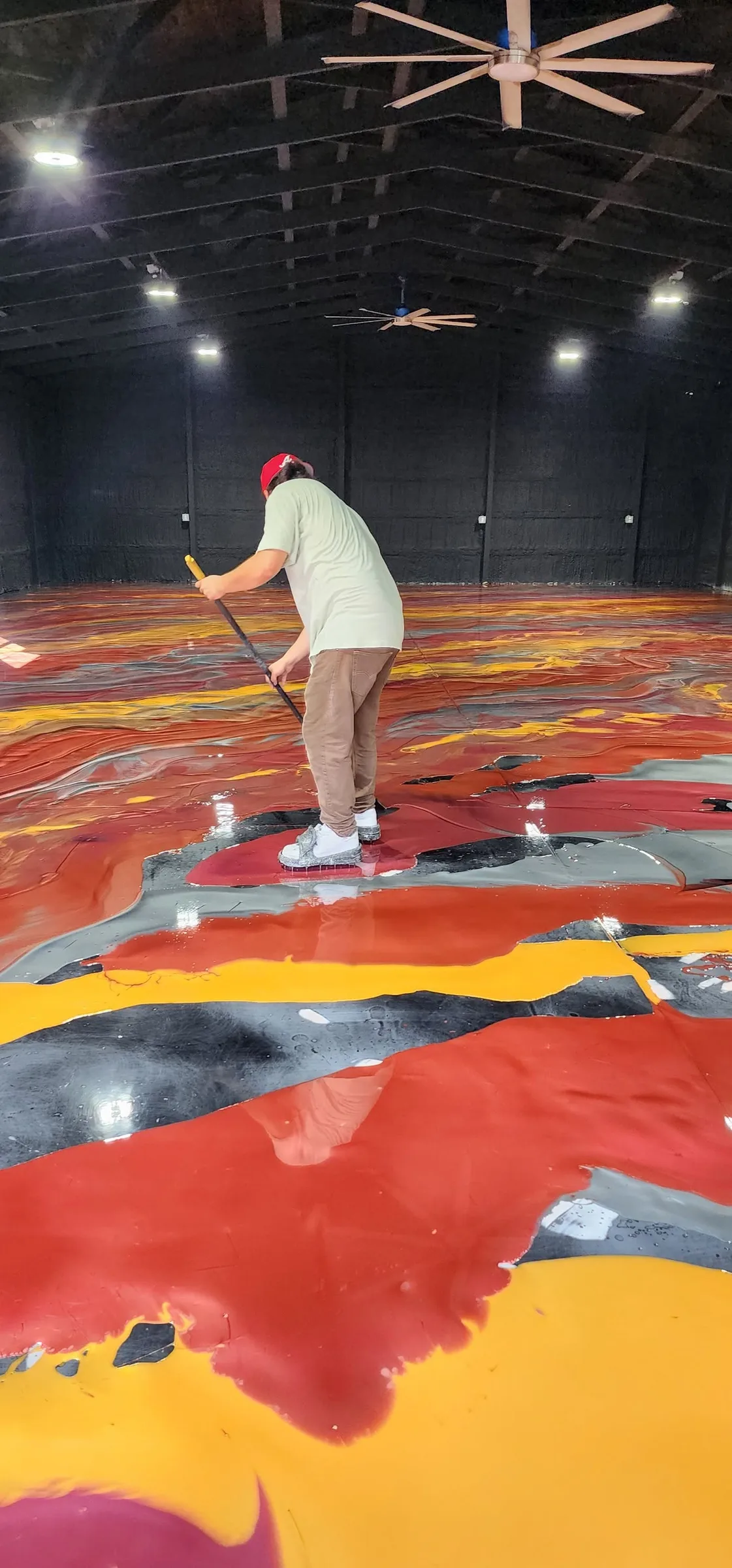
Material gets mixed fresh and worked across the floor while it is still workable.

Cure and the final walk
Cure time comes first, foot traffic second. Then a final look together.
More of Danny’s floors
Other jobs from the file, not all of them this service. See the gallery








Questions about home gym rubber and resin flooring solutions
Why not just put rubber on the whole floor?
You can, but rubber across a whole room is harder to clean, holds odor and makes rolling machines and carts harder to move. Most home gyms only need rubber where weights hit the ground. A coated floor everywhere else looks finished, wipes clean and leaves you free to rearrange.
Should the rubber go on top of the epoxy?
Usually, yes. Laying mats or tiles over a coated floor keeps the whole slab sealed and lets you move the lifting area later. The downside is a raised edge, which needs a beveled transition or a smart layout. Leaving a bare zone for rubber is possible when you want the area permanent.
Is this setup good for a garage gym?
It works well in a garage, with one extra thought. A garage floor also handles cars, salt and tires when the gym is packed up, so the coating is built for that, and the rubber zone has to be movable or placed in a bay the cars do not use. Danny plans the layout around both jobs.
How do I take care of the floor afterward?
Mostly a soft broom and a damp mop with a mild cleaner. Danny goes over care for your specific system at the final walk-through.
Do you come out and look before anything gets decided?
Yes. Danny walks the space, checks the concrete and talks through what you want before anything is ordered or scheduled. Call (908) 577-7104 or send the form and he will set a time.
Do you work on commercial spaces?
Yes. Salons, barbershops, showrooms, shops and offices, scheduled around your hours where the job allows it.
More from the residential section
Garages, basements, laundry rooms, mudrooms, home gyms and porches, each floor laid out for how the room gets used.
- Two-Car Garage Epoxy FlooringTwo-car garage epoxy done as one continuous floor, wall to wall, after everything comes out and the slab is ground and repaired.
- Three-Car Garage Epoxy FlooringThree-car garage floors coated as one system, with the option of a different finish or heavier build in the bay that does a second job.
- Oversized Garage Floor CoatingOversized garage floors for RVs, boats, lifts and collections, laid out in planned sections and built to the weight parked on them.
- Home Workshop Epoxy FlooringA sealed workshop floor in a light color that sweeps clean, takes spills and shows every screw that hits the ground.
- Basement Epoxy FlooringBasement floors with personality, often a metallic under recessed lights, poured on a dry slab for bars, media rooms and playrooms.
Jobs run about 60 miles out from the Cranford shop, from the Jersey shore and the Poconos to Long Island and Fairfield County. See every areaSee the gallery
Danz Handz
Danny Carrero, epoxy specialist
dhepoxy@gmail.com
Cranford, NJ. Mon to Sat, 8 to 6. Hablamos español.
Schedule a look at your floor
Send a few lines about the room and the look you want. Danny will call and set up a time to see it.