
Resurfacing concrete that is too rough to finish
Years of salt scaling, pitting, a broom finish worn uneven or a floor full of patches can leave nothing smooth enough to coat or polish. If the concrete underneath is still sound, resurfacing puts a new top on it. Danny checks that before anything else, since a resurfacer will not hold on a slab that is breaking up underneath.


Concrete Resurfacing, start to finish
Resurfacing builds a new, smooth layer on top of an existing slab. The old surface is ground to sound concrete, the worst damage is repaired, and a leveling layer is spread across the floor to fill pits, scaling and uneven spots so the surface is flat and even again. Once that has cured, the floor is ready for a coating, sealer or other finish. The new layer bonds to the old slab, so it depends on solid concrete underneath to hold.
It fits garages, basements and interior slabs with widespread surface damage: scaling, pitting and rough, uneven texture.
It fits garages, basements and interior slabs with widespread surface damage: scaling, pitting and rough, uneven texture. It is not a fix for a slab that is cracking from movement, sinking or breaking apart, which needs concrete work by another contractor. Small, scattered damage can usually be repaired without resurfacing. Danny looks at how much of the floor is affected and how deep the damage goes before deciding whether a full resurface makes sense.
Danny walks the slab and runs a hand across the damaged areas to feel how deep the scaling and pitting go. He checks whether the concrete under the damage is sound, since a resurface only holds on good concrete. He asks what the floor will be finished with. The surface is ground down to solid concrete, cracks and deep holes are repaired, and the leveling layer is spread across the floor and smoothed. After it cures, the finish goes on top. On the final walk, he checks the surface with you by eye and underfoot.
A resurfaced floor is only as strong as the slab it is bonded to.
How Danny does the job
A new layer bonded to old concrete is only as good as what is underneath, so the stages below spend as much effort proving the slab as placing the layer.


Scraper test on the damaged surface
Danny drags a stiff scraper across the scaled and pitted areas to see whether only the top flakes off or the concrete keeps crumbling beneath. A crumbling layer has to come off until the scraper meets hard, sound concrete, which can sit deeper than the visible damage.

Measuring the dips with a straightedge
A straightedge laid across the floor shows how deep the worst pits and low areas run. That tells him how much material the new layer must carry in those spots and whether some areas need a fill before the full surface goes down.

Grinding and priming the old slab
The damaged top is ground away to firm concrete, edges along walls and thresholds included, and the slab is cleaned of every bit of dust. A bonding primer goes on where the resurfacing product calls for it, so the new layer grips the old.

Mixing and spreading in batches
The resurfacer is mixed in batches small enough to place before it stiffens and spread across the floor in sections, with each batch blended into the last while both are still workable. Joint lines are marked on the wall so they can be found and recut once the layer hardens.
Curing before the finish goes on
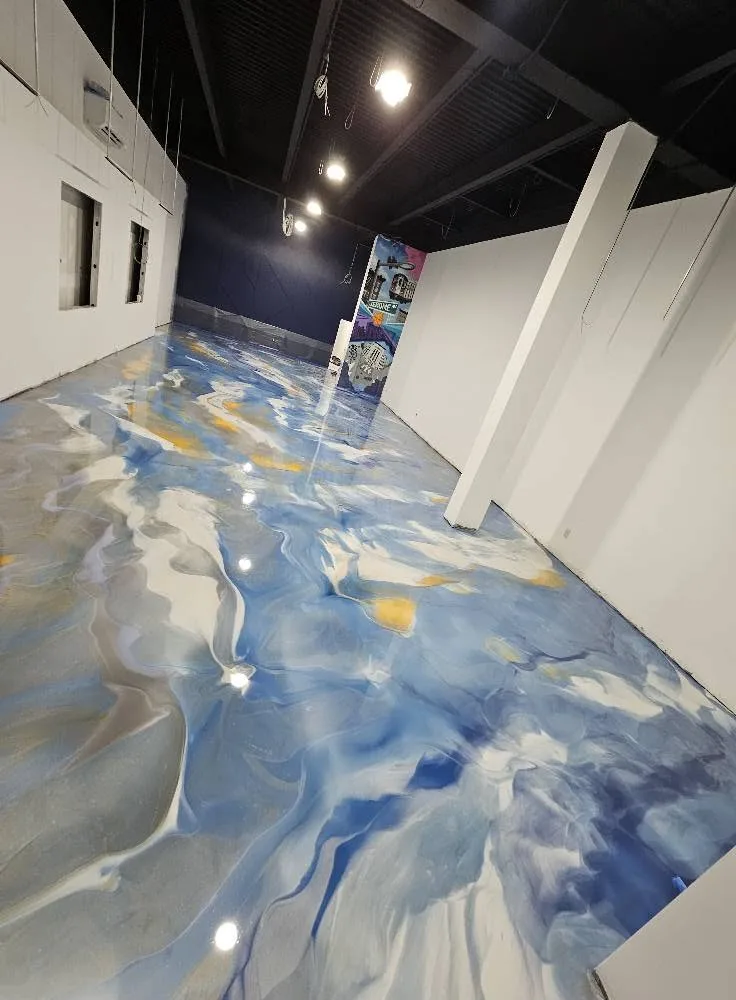
The new surface is left to cure as its product data directs before anything goes over it, then lightly ground and vacuumed. Flake, solid color, a metallic or a clear sealer follows, and the final walk includes the doorways, where a resurfaced floor meets the old ones.
More of Danny’s floors
Other jobs from the file, not all of them this service. See the gallery






Questions about concrete resurfacing
When does a floor need resurfacing instead of repair?
When the damage covers much of the floor, like widespread scaling or pitting, spot repairs would leave a patchwork. Resurfacing gives the whole floor a new, even surface. When the damage is in a few areas, repairs are usually enough. Danny walks the floor and tells you which approach fits.
Can a resurfaced floor be coated with epoxy?
Yes. Resurfacing is often done as the base for a coating, giving the epoxy a smooth, even surface to go onto. Once the leveling layer has cured, the floor is prepared and the coating system goes on as usual, including flake, solid color or metallic.
Will resurfacing fix cracks in my slab?
It fills and covers cracks from age and shrinkage. Cracks caused by movement, like settling or heaving, can come back through a new layer, and a slab that is still moving needs a concrete contractor first. Danny checks the cracks during the walk and tells you what he sees.
Can a garage floor damaged by salt be resurfaced?
Yes, as long as the scaling is in the surface and the concrete beneath is still hard. Salt damage is one of the most common reasons garages get resurfaced, since it leaves a rough, pitted floor near the door. The new layer then needs protection from the following winters’ salt, usually a coating or a sealer suited to a garage.
How smooth will a resurfaced floor be?
Smooth enough to coat or seal without the old pits and scaling showing through. A resurfacer is spread and leveled by hand, so it follows the general plane of the slab instead of making a crooked floor perfectly flat. Where flatness matters, such as under a metallic, Danny plans extra leveling and grinding before the finish.
Can a resurfaced floor be left without a coating?
It can, with a sealer. A bare resurfacer looks like fresh, even gray concrete and is sound to walk on, though it will stain and dust like any bare concrete without protection. Most owners put a coating or at least a sealer over it. Danny talks through which suits the room before the resurfacing is scheduled.
Other sealing work
Sealing, densifying, polishing and waterproofing for the slabs that do not need a full coating.
- Concrete Floor Coating ConsultationA walk of your slab with Danny to sort out its condition, how the room gets used and the look, then land on a system.
- Concrete SealingClear sealers on bare concrete that keep the slab looking like itself while cutting down on dust, stains and spills soaking in.
- Garage Concrete SealingClear sealer on a bare garage slab to slow road salt, oil and grit from soaking in, while the floor keeps its concrete look.
- Commercial Concrete SealingClear sealers for exposed concrete in shops, offices and storage rooms, cutting dust and stains while keeping the slab’s own look.
- Industrial Concrete SealingHardening and sealing for warehouse and plant slabs, done in zones to cut forklift dust and staining while the facility keeps running.
Every county Danny covers, and every town in them, has its own page. See every areaSee the gallery
Danz Handz
Danny Carrero, epoxy specialist
dhepoxy@gmail.com
Cranford, NJ. Mon to Sat, 8 to 6. Hablamos español.
Tell Danny about the floor
Tell Danny about the space. He calls you back, comes out, looks at the concrete and talks it through before anything gets decided.