
Clear topcoats that take the wear instead of the floor
Gloss, satin, texture or a little glitter: the topcoat sets how a coated floor looks and takes the scuffs that would otherwise reach the color. On a new floor Danny picks it to suit the room, and on an older one that has gone dull and scratched he puts down a fresh wear layer.


What protective concrete topcoats really involves
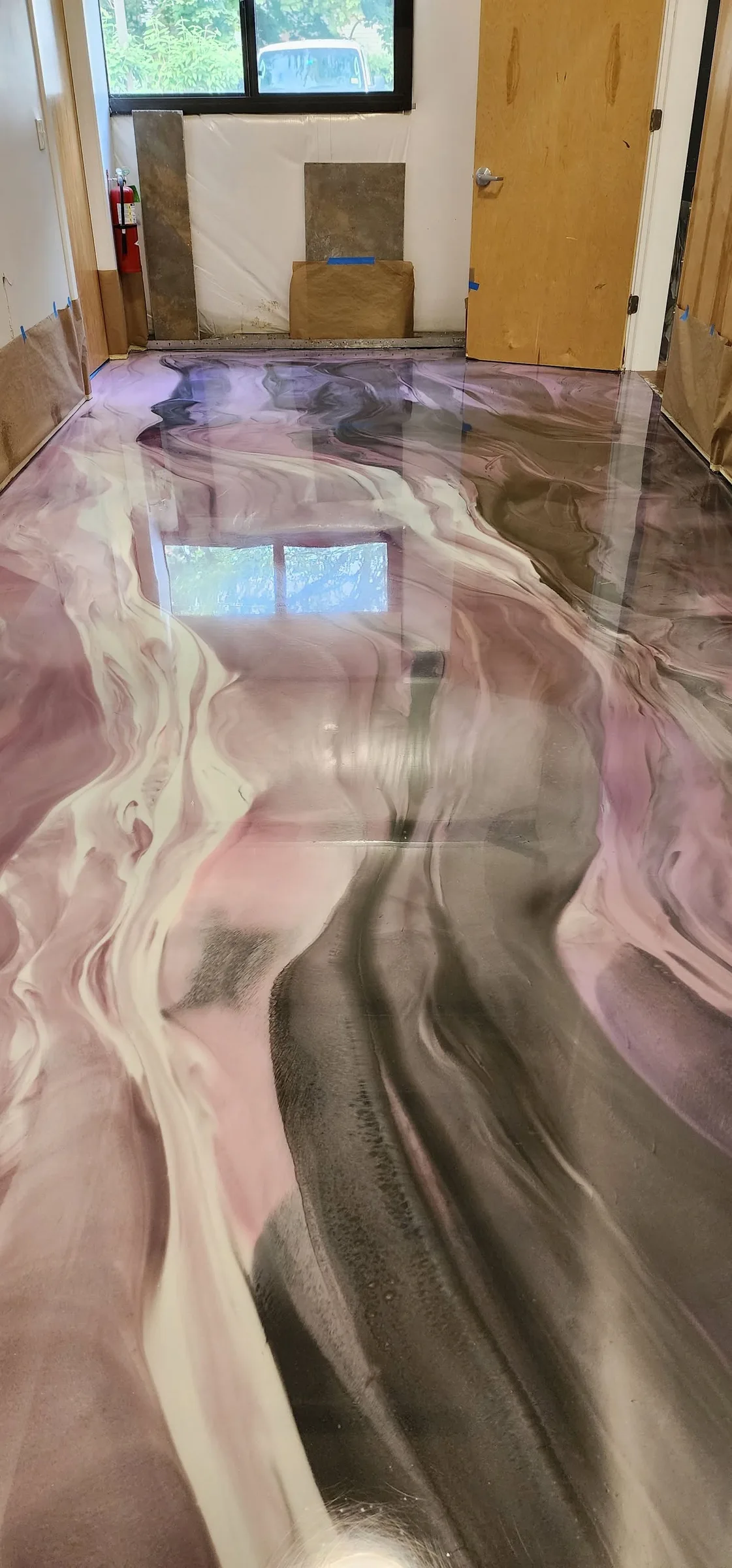
The topcoat is a clear layer poured or rolled over the base coats of an epoxy, flake or metallic floor. It sets the sheen, from high gloss to a softer finish, and it is what feet, tires and chair legs actually touch. On a metallic floor, where Danny spends much of his time, the topcoat protects the color work underneath so the movement in the pour stays clean. Topcoat products wear differently from one another, and Danny chooses one from the product data and the way the room is used.
He looks hard at the edges, the doorways and the spots under where heavy things sit.
A fresh topcoat fits a coating that is still bonded well but looks tired: dull traffic lanes, fine scratches, a haze where the gloss used to be. It does not fit a coating that is peeling, bubbling or lifting at the edges. Putting a new top on a loose base just traps the problem. In that case the old system comes off and the floor starts over. Danny also tries a new topcoat on a small area first when he cannot tell what the existing coating is.
On a recoat, Danny walks the floor and checks how well the existing coating is holding. He looks hard at the edges, the doorways and the spots under where heavy things sit. Sound areas get ground or sanded to give the new layer something to grab, and chips get repaired and leveled so they do not show through. Then he pours or rolls the topcoat and lets it cure with the room closed off. On a new floor the topcoat is simply the last step of the pour. The final walk covers cleaning, mats and what scratches the finish.
Most of what people call floor wear is really topcoat wear.
The order the work goes in
A fresh topcoat is only as good as the coating under it, so the job begins with a bond test and ends with a clear layer rolled out in one pass.


Testing the old coat’s grip
Danny presses tape onto a few spots, scrapes at the doorways and edges, and listens for hollow areas under where heavy furniture sits. A coating that stays put through all of that can take a fresh top, and any part that lifts gets marked for removal.

Scuffing the finish for a bond
A glossy coating gives a new layer nothing to hold, so the whole surface is sanded or lightly ground until it turns dull and even. The scratches left behind are fine ones, and they vanish once the clear coat flows over them.

Patching chips flush with the base
Chips that reach the color layer get filled and sanded level before anything clear goes on, since a topcoat magnifies whatever sits under it. On a metallic floor the patch is kept small so the movement in the original pour stays readable.

Settling sheen and any sparkle
This is where the look of the top gets decided: high gloss, satin or a softer finish, and whether some Glitter ELEMENTZ goes into the clear layer. Danny chooses the topcoat product from its data and from how the room gets used day to day.

Rolling the wear layer out
The clear coat is poured and rolled out in one continuous pass so no lap lines dry into it, then the room is shut while it cures. Afterward the owner walks the floor with Danny and sees the new sheen under the room’s own light.
More of Danny’s floors
Other jobs from the file, not all of them this service. See the gallery







Questions about protective concrete topcoats
Can you put a new topcoat on my old epoxy floor?
Often, yes, if the old coating is still holding tight to the concrete. Danny checks for peeling, lifting and soft spots first. A sound floor gets sanded or ground lightly, repaired where it is chipped and then topcoated. If the base is failing, a new topcoat would only cover the problem for a short while, so he will recommend starting over.
Does a topcoat change the color of my floor?
A clear topcoat deepens the color a little, the way water does on stone, and it changes the sheen. It does not change the base color. If the base has faded, scratched through or stained, a topcoat will not hide that, and Danny will say so when he looks at the floor.
How do I keep a topcoat looking good?
Sweep grit off often, since grit under shoes is what dulls a finish fastest. Mop with a neutral cleaner and skip harsh solvents unless the product data allows them. Put mats at the doors and pads under furniture. When a traffic lane starts to dull, a recoat can bring it back before the wear reaches the base coats.
Can glitter go into the topcoat?
Yes. Glitter can be mixed into or broadcast across a clear topcoat so it catches light without changing the color underneath. Danny sells his own Glitter ELEMENTZ line, an ultra-reflective polyester glitter made for epoxy and resin. A little goes a long way on a floor, and he helps the owner decide how much sparkle suits the room.
Which sheen hides scratches best?
Lower sheens hide fine scratches and dust better, because there is less reflection to show them. High gloss looks deepest and shows off a metallic pour, though every scuff catches the light. In a busy garage or kitchen, satin is often the easier choice. Danny can show both on the same floor so the owner sees the difference.
What signs say a floor is due for a fresh topcoat?
Look at the traffic lanes in low, raking light. When the path from the door looks duller than the corners, or fine scratches gather where chairs slide, the top is wearing. Recoating then keeps all the wear in the clear layer. Waiting until scratches reach the color itself means more repair work before anything new goes on.
Close to this one
Sealing, densifying, polishing and waterproofing for the slabs that do not need a full coating.
- Concrete Floor Paint RemovalPeeling floor paint ground off down to bare concrete, so the slab can take a sealer, polish or coating that bonds properly.
- Concrete WaterproofingSealers and coatings that keep surface water on top of a basement or garage slab, with an honest read on water coming from below.
- Concrete Moisture MitigationA moisture-mitigating base layer under the coating for slabs that push vapor up from below, chosen from a third-party moisture test.
- Concrete Floor RestorationOld, worn slabs ground clean, repaired and leveled, then sealed, polished or coated, with good concrete brought back under the finish.
- Concrete ResurfacingA new leveling layer over a sound slab with a scaled, pitted or rough surface, ready for a coating, sealer or metallic finish.
Every county Danny covers, and every town in them, has its own page. See every areaSee the gallery
Danz Handz
Danny Carrero, epoxy specialist
dhepoxy@gmail.com
Cranford, NJ. Mon to Sat, 8 to 6. Hablamos español.
Book a walkthrough
Describe the floor and what you have in mind. Danny calls back and comes out to look at it.