
When a floor coating is peeling up in sheets
Peeling at the edges, bubbles that crack open, patches you can lift with a fingernail: that is a coating letting go of the concrete. On a contractor’s floor or a store-bought kit, the cause is usually the prep underneath. Danny looks at what it was bonded to, and how, before saying how much of the floor can stay.


How Danny approaches delaminating coating repair
A delaminating coating has lost its bond, either to the concrete or between its own layers. The usual causes are a slab that was never ground, a coating poured over sealer, dirt or old paint, moisture coming up through the concrete, and hot tires pulling a weak coating loose. Repair starts with finding out which one applies, because the fix follows the cause. The loose coating comes off back to edges that are firmly attached, and the exposed concrete is ground before anything new goes down.
From there he lays out the repair, which can be a section cut back to sound coating or full removal by grinding.
Peeling confined to a doorway or a single parking spot can sometimes be cut back and repaired. When the coating is letting go across the floor, patching only moves the problem around, and the honest answer is removal and a new floor. Moisture is the case to take seriously. If water vapor coming up through the slab caused the failure, a new coating will fail the same way unless the system is chosen for it, and the owner may need a third-party moisture test before that call is made.
Danny walks the whole floor, lifting at the peeled edges and checking the areas that still look fine, because a coating that is failing in one spot is often weak in others. He looks at the back of the loose pieces too. Concrete stuck to the back, clean bare coating and old paint each point to a different cause. From there he lays out the repair, which can be a section cut back to sound coating or full removal by grinding. The slab is then ground, repaired and leveled, the new coating is poured, and after the cure he walks it again with you.
The back of a peeled piece of coating tells you why it peeled.
How Danny does the job
Delamination work follows the bond and finds exactly where it stops, so the stages below run from a look at the loose edge to new layers on freshly ground concrete.
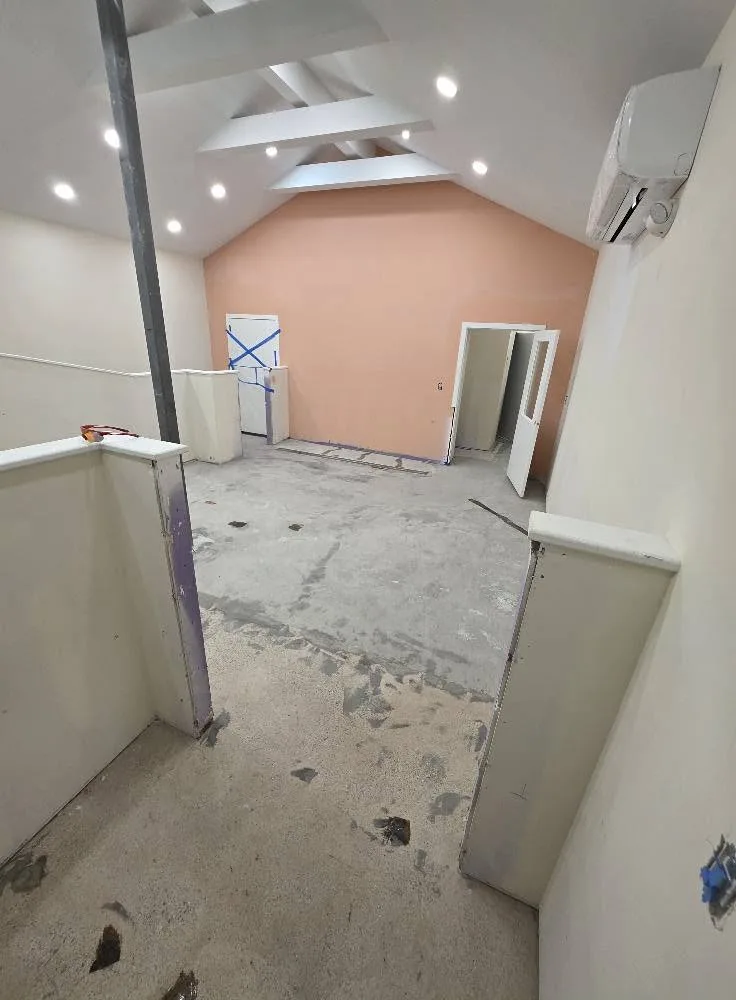

Which layer let go
Danny looks at a lifted edge from the side to see whether the whole system came off the concrete or only the top layers separated from the base. Failure between coats and failure at the slab call for different repairs, so this one question shapes everything that follows.

Chalking the loose boundary
A screwdriver handle tapped across the floor finds the hollow areas around each visible peel, and the boundary is outlined in chalk. The outline usually runs well past the peeling anyone could see, and Danny shows the owner its full size before any plan is set.

Lifting everything inside the line
Loose coating inside the chalk line is scraped and ground off until the edges stop flaking. Where the failure was between layers, the sound base coat may stay, sanded for grip, instead of grinding all the way to concrete. Edges are feathered so the new work does not leave a step.

Fixing what broke the bond
Whatever broke the bond gets dealt with on the open slab, such as residue from an old sealer ground out or oil drawn from the pores. If the signs point to moisture, the owner arranges a third-party test, and the new layers are chosen with that result in hand.

Rebuilt layers, final pull test
Primer, color and topcoat go back in the cleared areas and are carried over the whole floor when the edges would show. After the cure, Danny works a blade at the new edges with the owner watching, so both see the repair holding where the old coating let go.
More of Danny’s floors
Other jobs from the file, not all of them this service. See the gallery







Questions about delaminating coating repair
Can you coat over the peeling areas?
No. A new coating poured over a failing one only sticks as well as the old layer below it, and the old layer is already letting go. Every loose section has to come off back to firmly bonded coating or bare concrete, and the slab gets ground before the new coating goes down.
What causes a coating to peel?
Most often the slab was not properly prepared, so the coating sat on a smooth, sealed or dirty surface and never gripped. Moisture rising through the concrete is another cause, and so are hot tires on a thin garage coating. Danny looks at the failed pieces and the slab underneath to work out which applies before recommending a fix.
Should I patch the peeling spots or replace the floor?
If the peeling is in one area with a clear cause, like a doorway that took on water, a section repair can make sense. If it is scattered across the floor, the bond is weak everywhere and patches will keep failing around their edges. Danny shows you what he finds and recommends one or the other plainly.
Can one coat of a floor peel away from another coat?
Yes. When a topcoat or second color coat goes on after the layer below has cured too far, or over a surface that was never sanded, the layers can split apart while the base stays stuck to the concrete. That kind of failure is often smaller to fix, since the bonded base can stay and only the upper layers are redone.
How quickly does delamination spread once it starts?
It depends on the cause. A failure from one spilled solvent or a single wet doorway can stay put for a long time. A floor that never bonded well tends to keep letting go wherever wheels, heat or water work at a loose edge, and the peeling widens each season. Danny reads which kind you have from where and how it started.
Can a delaminated garage floor wait until spring for repair?
It can, with some care. Sweep up loose pieces so they are not ground into sound coating, rinse salt off through the winter and leave the edges alone. Expect the loose area to grow somewhat. Coating work in a cold garage needs temperatures within the product’s range, so spring scheduling often suits the repair better.
Other repair work
Peeling, bubbling, chipped or faded coatings, patched or recoated, plus upkeep plans for floors that work hard.
- Commercial Floor Coating RestorationTired showroom, store and restaurant floors repaired, sanded and recoated as one even finish, scheduled around the hours the business is open.
- Industrial Floor Coating RepairsForklift ruts, dock gouges and worn work zones repaired in planned sections, so warehouse and plant floors stay running around the work.
- Concrete Joint ResealingFailed joint filler cut out, broken edges rebuilt and joints refilled flush, so wheels roll across and dirt stops packing into the slab.
- Floor Coating Maintenance ProgramsReturn visits on a schedule you choose, catching chips, dull lanes and worn topcoats early so a coated floor stays ahead of its wear.
- Epoxy Floor Deep CleaningCleaner haze, tire marks and ground-in grime stripped off a dull epoxy floor, so you see what it really looks like before deciding on repairs.
Based in Cranford, NJ. Danny takes work across New Jersey, the five boroughs, Long Island, Westchester and Rockland, Fairfield County and Bucks County. See every areaSee the gallery
Danz Handz
Danny Carrero, epoxy specialist
dhepoxy@gmail.com
Cranford, NJ. Mon to Sat, 8 to 6. Hablamos español.
Schedule a look at your floor
Tell Danny about the space. He calls you back, comes out, looks at the concrete and talks it through before anything gets decided.