
Filling cracks so they stay out of the finish
Cracks are usually the first thing homeowners point to at the walk-through, and most garages and basements have a few. Filling closes the hairlines and the wider ones before a coating goes down so they do not read through the finish or collect dirt, and Danny sorts the cracks that have stopped moving from the ones that have not.

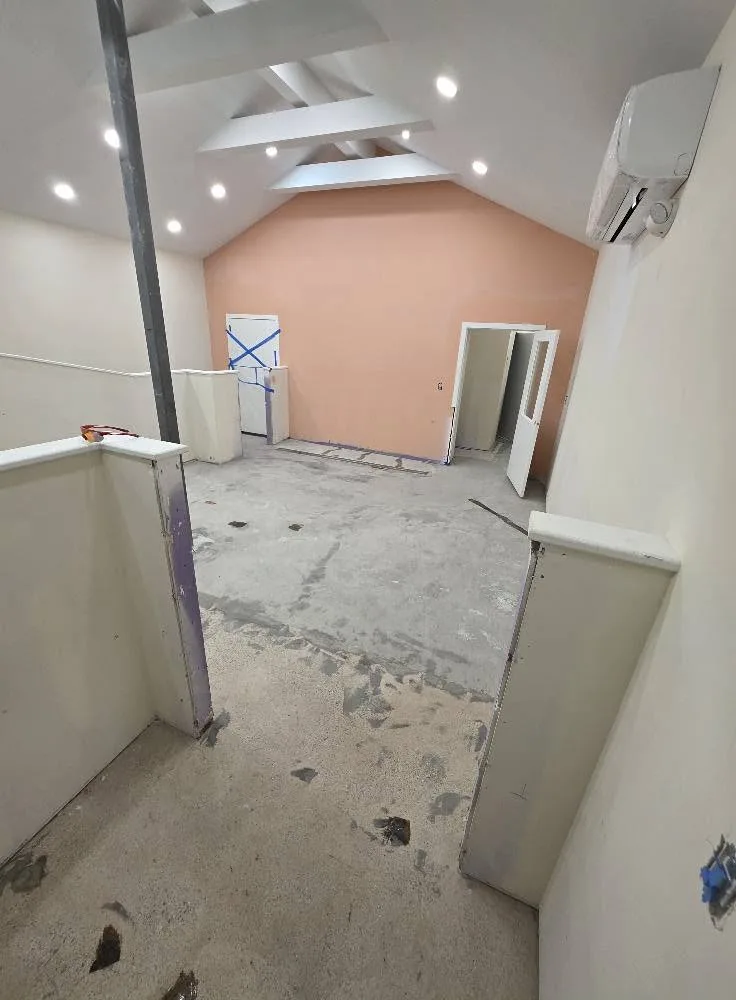
Concrete Crack Filling, from Danny’s side of the job
Before filling, Danny opens each crack with a grinder or a crack-chasing blade so the filler has clean, solid edges to grab, with the loose dust and old sealant gone. Then he fills it with a rigid epoxy or a fast-setting polyurea filler, depending on the crack and the system going on top, sometimes mixed with sand to build it up. Once it hardens, the fill is ground flush with the slab so the coating goes over a flat surface. Wider cracks may get filled in more than one pass.
In a decorative floor, he thinks about how the fills will look under the finish and blends them in.
Filling fits cracks that have stopped moving, such as shrinkage cracks, old settlement cracks and cracks from the first years of a slab’s life. It does not stop a slab that is still moving or settling, and a crack that keeps opening and closing can return through a rigid fill and the coating over it. Cracks with height differences between the two sides, or with water coming through them, are a different problem. Danny looks for those signs and says so when a crack needs more than filling.
During the walk-through Danny maps the cracks and looks at each one: how wide it is, whether the sides line up, whether there is moisture and whether it looks like it is still moving. That decides the filler. On the day, cracks get chased open after the main grinding pass, vacuumed clean of dust and filled, with extra material left above the surface. When the filler hardens, he grinds it flush and checks it by hand. In a decorative floor, he thinks about how the fills will look under the finish and blends them in. Then the slab is vacuumed before the coating.
A filled crack can still return if the slab under it keeps moving.
From bare slab to finished floor
Each crack gets its own short process: judge it, open it, fill it, flatten it and decide how it will sit under the finish.


Sorting stable cracks from moving ones
Danny looks at each crack’s width, whether its edges line up, any dampness and signs of fresh movement. He also asks the owner whether a crack has grown. Stable cracks get filled, and moving ones get an honest conversation first.

Chasing each crack open
After the main grind, each crack is opened with a crack-chasing blade or a grinder so the filler meets clean, solid concrete on both walls. Loose debris is blown out and vacuumed from deep inside the crack before anything goes in.

Picking a filler for each crack
Rigid epoxy or a fast-setting polyurea goes in, depending on the crack and the system going on top. Wide cracks can take sand mixed in for body, and deep ones get filled in more than one pass so the fill does not sink.

Overfill, then grind flush
Each fill is left slightly proud of the surface, then ground flat once it hardens and checked by hand. A sunken fill would show as a groove under the coating, so any low one gets topped up and ground again.

Blending fills under the finish
On decorative floors, Danny considers how each filled line will look under the chosen finish and blends it into the base color plan. Then the slab is vacuumed and handed on to the coating stage with every crack closed.
More of Danny’s floors
Other jobs from the file, not all of them this service. See the gallery








Questions about concrete crack filling
Will the cracks show through my new floor?
Filled and ground flush, most cracks disappear under the coating. If the slab keeps moving, a crack can return as a thin line in the finish. Flake and quartz systems hide that best. On smooth metallic or solid floors, Danny will tell you which cracks he thinks might reappear before you choose the look.
Why do you make the crack bigger before filling it?
A crack straight out of the slab has dust, old sealant and weak edges inside it. Opening it with a grinder or blade gives the filler clean, solid concrete to bond to on both sides. A fill pushed into a dirty crack tends to sink or pop out later, and that shows through the coating.
Can you fix a crack that is still growing?
Filling will not stop it. A crack that keeps opening usually has a cause underneath, like soil movement or drainage, and that may need a different trade. Danny can fill it and coat over it with the understanding that it may return, or point you toward the repair it needs first.
Can cracks be filled without coating the floor?
They can, though the filler usually shows as a darker or lighter line on bare concrete, so it looks like a repair. Most clients have cracks filled as part of a coating job, where the lines disappear under the finish. For a floor that will stay bare, Danny talks through how the fills will look.
Why does my basement slab have so many cracks?
Most basement cracks are shrinkage cracks that formed as the concrete dried after it was poured, and they are usually cosmetic. Danny checks whether any crack lets water in, has edges at different heights or keeps growing, since those signs point to something beyond shrinkage and change the plan.
Do hairline cracks need filling under a flake floor?
Very fine hairlines often get covered by the base coat and chips. Danny still chases and fills the ones that can be opened, because a hairline that moves a little can show as a faint line even under flake. It takes little time compared with fixing a line that appears later.
More from the prep section
Grinding, shot blasting, crack and joint filling, leveling and moisture testing, done before any coating goes down.
- Diamond Concrete GrindingGrinding with diamond tooling picked for how hard your slab is and what has to come off, the standard prep under Danny’s coatings.
- Concrete Floor Surface PreparationThe full sequence before the first coat, assessment, removal, grinding, repairs and cleaning, that decides whether a coating stays on the floor.
- Concrete Shot BlastingSteel-shot blasting to strip and texture large, open slabs before commercial coatings, with the edges finished by a hand grinder.
- Concrete ScarificationRotating steel cutters chip off thick coatings, overlays and raised edges when diamond grinding alone would take far too long.
- Concrete Coating RemovalStripping failed paint, sealers and old coatings back to sound concrete, with the method picked after testing how the old finish comes off.
Jobs run about 60 miles out from the Cranford shop, from the Jersey shore and the Poconos to Long Island and Fairfield County. See every areaSee the galleryRead: Why Every Good Epoxy Floor Starts With a Diamond Grinder
Danz Handz
Danny Carrero, epoxy specialist
dhepoxy@gmail.com
Cranford, NJ. Mon to Sat, 8 to 6. Hablamos español.
Tell Danny about the floor
Send a few lines about the room and the look you want. Danny will call and set up a time to see it.