
Renewing the clear topcoat before the color wears
The clear topcoat takes the wear so the color and flake underneath do not have to. Renewing it on time, while the floor still looks good, keeps foot and tire traffic off the layers that are much harder to replace. Danny checks how thin the topcoat has worn in the busy lanes to set the timing.


The short version of protective topcoat renewal
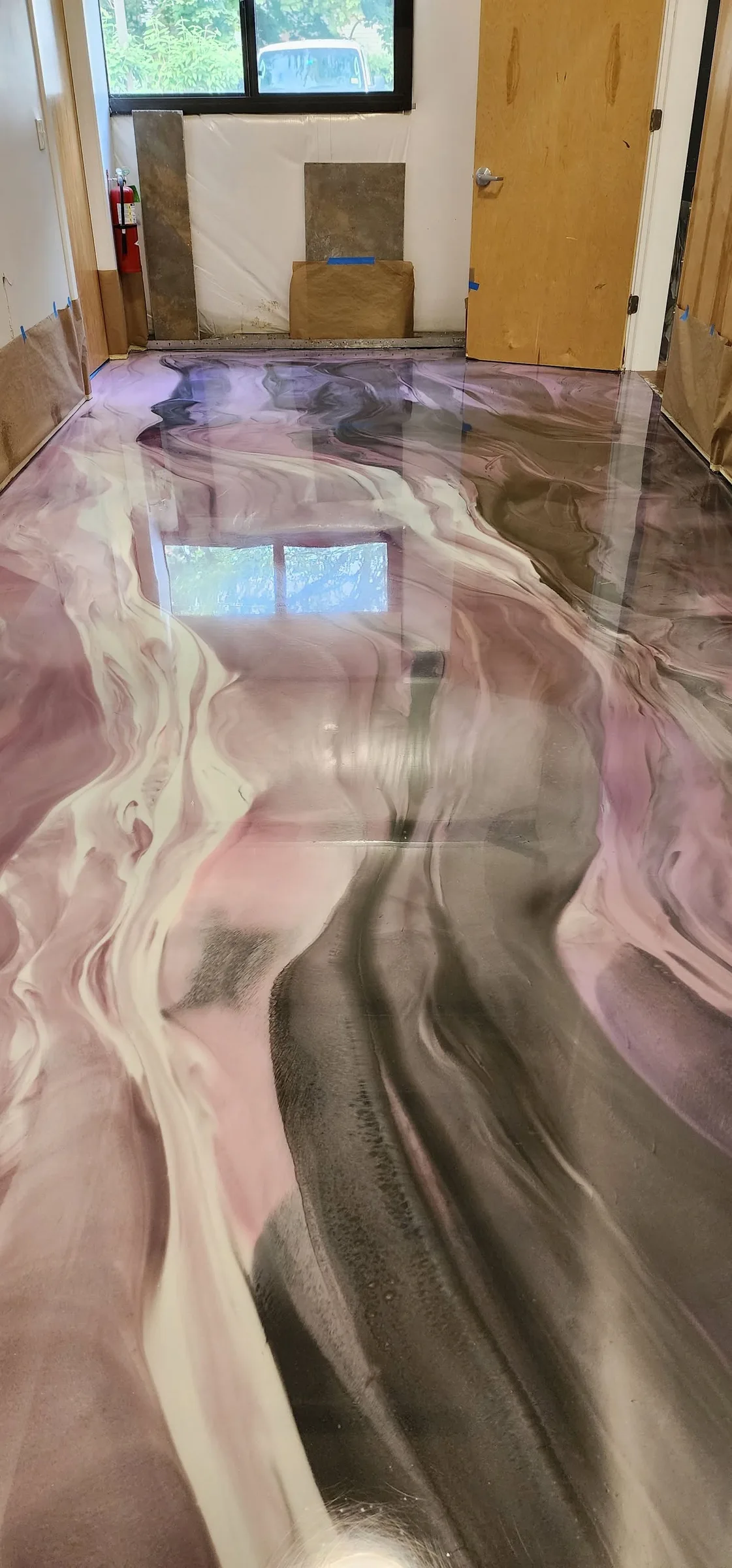
Topcoat renewal adds a new clear layer over a floor whose base and color are still in good shape. The existing topcoat is cleaned and sanded so the new one bonds, and a fresh clear coat is poured across the whole floor. Nothing below the topcoat is disturbed. Think of it as routine work on the floor’s wear layer, done on the floor’s schedule instead of waiting for visible damage. It is also a chance to change the sheen, from gloss to satin or back.
Then the room is cleared and closed, the floor is cleaned of any residue, and the old topcoat is sanded evenly so the new layer has something to grip.
It fits floors that are bonded, intact and starting to show light dulling or fine wear in the topcoat. It is the simplest and least disruptive work a coated floor gets. Once the wear has broken through to the color or the flake, the job grows into a recoat with color work, and if the coating is peeling anywhere, that has to be repaired first. The new topcoat is chosen to the room’s use and sun exposure, going by the product data.
Danny walks the floor and looks closely at the topcoat in the busiest areas, checking whether wear has stayed in the clear layer or started reaching the color. He confirms the coating is bonded across the room, including the edges at doors and walls. Then the room is cleared and closed, the floor is cleaned of any residue, and the old topcoat is sanded evenly so the new layer has something to grip. The dust is cleaned up completely before the new clear coat is poured wall to wall. After the cure, he walks the floor with you and checks the finish in the room’s normal light. Danny works with Bulletproof Resins material on his floors and keeps the mixing in small, measured batches.
The topcoat is there to wear out, so the color underneath does not.
How Danny does the job
Every floor goes through the same five stages. What changes is how much each one takes, and that gets settled at the walkthrough.


Walk the space
First visit is a look at the concrete and a talk about the look you want and how hard the floor works.

Prep the concrete
Prep is grinding and cleaning, done until the concrete is ready to take a coating, not before.

Fix what is underneath
Cracks, pits, spalls and low spots get filled and leveled before the first coat goes down.

Lay it down
Mix, spread, finish. Each coat goes on clean, in the order the system needs.

Cure and the final walk
The room stays closed for the cure time Danny gives you up front, then you walk the floor together.
More of Danny’s floors
Other jobs from the file, not all of them this service. See the gallery







Questions about protective topcoat renewal
How do I know when my topcoat needs renewing?
Look for dulling or fine wear in the paths people use most, while the color and flake underneath still look crisp. That is the window. If you see the color fading or flake wearing in those paths, the floor has gone past a simple renewal. Danny can walk the floor and tell you where yours sits.
Does renewing the topcoat change how the floor looks?
It brings back the depth and shine the floor had when it was new, since the color shows through a clear, unworn layer again. It can also change the sheen if you want it to. The color, flake and any metallic pattern stay exactly as they are underneath.
Can a new topcoat go over a floor someone else installed?
Usually, if the existing coating is well bonded and the topcoat accepts a new layer. Danny checks the floor’s bond and condition first, and it helps to know the original product. If the coating has problems from the first install, he will tell you before adding anything on top.
How do I take care of the floor afterward?
Mostly a soft broom and a damp mop with a mild cleaner. Danny goes over care for your specific system at the final walk-through.
Do you teach epoxy too?
He has run hands-on epoxy classes in Cranford for the last three years. The training page covers what a class goes through.
Who actually does the work?
Danny does. He walks the space, plans the floor with you and runs the pour, so the person you talk to on the phone is the one on your job.
Other repair work
Peeling, bubbling, chipped or faded coatings, patched or recoated, plus upkeep plans for floors that work hard.
- Cracked Epoxy Flooring RepairCracks ground open, filled and recoated to match, with active cracks turned into proper joints so the line does not keep coming back.
- Scratched Epoxy Floor RestorationScratched, hazy topcoats sanded evenly and recoated wall to wall, so a glossy or metallic floor gets its clarity back without a full redo.
- Chipped Epoxy Floor RepairImpact chips from tools, weights and shovels ground back to sound coating, filled and rebuilt, with flake or color matched to the floor around them.
- Delaminating Coating RepairPeeling and lifting coatings removed back to sound bond, the cause tracked down, and the slab ground and recoated so the failure does not repeat.
- Discolored Epoxy Floor RepairYellowed, tire-marked or stained epoxy floors cleaned, sanded and recoated, with the topcoat chosen around how much sun the room actually gets.
Every county Danny covers, and every town in them, has its own page. See every areaSee the gallery
Danz Handz
Danny Carrero, epoxy specialist
dhepoxy@gmail.com
Cranford, NJ. Mon to Sat, 8 to 6. Hablamos español.
Book a walkthrough
Tell Danny about the space. He calls you back, comes out, looks at the concrete and talks it through before anything gets decided.