
Classroom floors built around the school calendar
A classroom floor job really starts in the winter, with a walk through the rooms while kids are still in them, so Danny can see where the tile has failed. The pour waits for summer break. Once it is down, custodians stop stripping and rewaxing every year.


What goes into school and classroom floor coatings
A classroom coating is a resin floor poured over the slab where vinyl tile used to be, giving the room one continuous surface. There is no wax to strip and reapply each year, and spills sit on top until they are wiped up. Solid colors and flake are the common choices, and some schools use color to mark zones in a room, like a reading corner or the space in front of a board. Art rooms and maker spaces get a mid-tone flake that hides paint and glue.
The planning visit happens while school is still in session, so Danny can see how each room is used and where the old floor has failed.
Schools often have their own flooring specifications, purchasing rules and approval steps. Danny works from whatever the school or district requires and chooses the system to it using the product data, and he does not make safety or compliance claims beyond that. The biggest limit is time. A classroom has to be empty for grinding, the pour and the cure, which in practice means the summer break or a long holiday. Planning starts months ahead. Gyms and auditoriums with wood floors are a different job.
The planning visit happens while school is still in session, so Danny can see how each room is used and where the old floor has failed. He walks it with the facilities manager and notes which rooms are first priority and which can wait. When break begins, furniture comes out, old tile and adhesive come up, the slab is diamond ground, and cracks get repaired. The pours are sequenced room by room so the building is ready before teachers return to set up. Each room gets a final walk with the facilities team before the desks go back in.
In a school, the floor schedule is set by the calendar long before anyone grinds.
What happens on the job
School floor work happens in two seasons: a planning visit during the school year and the work itself during break. These stages connect the two.


Ranking rooms by condition
Danny and the facilities manager go room by room and rank each one by how badly its floor has failed: loose tile, cracked squares, wax buildup that never comes clean. The worst rooms go first on the list in case the break runs short.

Staging furniture out of the way
Desks, chairs and shelving have to leave each room. The school decides where they go, often the gym or a hallway not being worked, and the order of rooms is set so furniture is not moved twice.

Lifting tile once testing is cleared
In older schools, the old tile and adhesive are tested by the district before anyone disturbs them. Once cleared, they come up, the slab is ground, and cracks and holes left by old fixtures are repaired so the floor is flat.
Pouring in the summer sequence
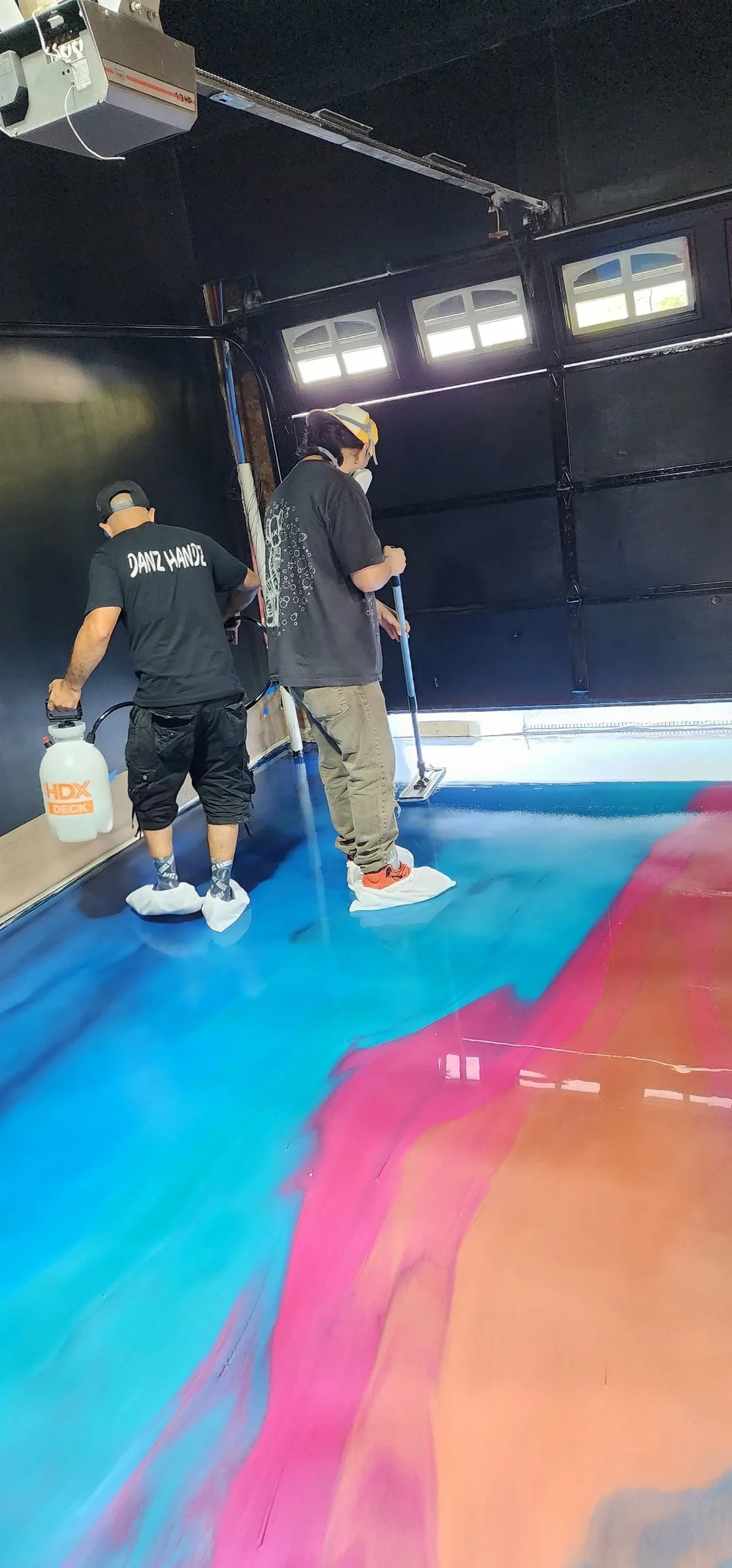
Rooms are poured in the agreed order, with any color zones laid out with the teacher’s sketch in hand. Science and art rooms get a mid-tone flake, and standard classrooms usually a calm solid that keeps the room bright.

Custodian walk before teachers arrive
Before teachers come back to set up, Danny walks the finished rooms with the head custodian. He goes over dust mopping, the right neutral cleaner, and why the stripping machine stays in the closet for these rooms.
More of Danny’s floors
Other jobs from the file, not all of them this service. See the gallery




Questions about school and classroom floor coatings
Does a coated classroom floor need waxing?
No wax and no yearly stripping. Custodians dust mop and damp mop it with a neutral cleaner. Over many years, the topcoat in the busiest paths will dull, and it can be recoated during a break without tearing out the floor. That maintenance pattern is the main reason schools look at coatings in the first place.
Can you finish several classrooms over one summer?
That depends on the number of rooms, the condition of the slabs and the system chosen. Danny walks the building, then lays out which rooms fit in the break and in what order. If the list is long, schools often split it across two summers, starting with the rooms in the worst shape.
Can the floor show learning zones or colors?
Yes. Different colors can be poured in defined areas of a room, like a rug-sized circle for story time or a band along the board. Simple shapes work best. Danny can sketch the layout with the teacher or facilities manager before the pour so everyone agrees on where the lines go.
Who tests the old floor tile in our building?
That is arranged by the school or district before grinding starts, through whoever handles their environmental testing. Danny does not do the testing himself. He asks for the results as part of planning, and if any tile needs special removal, that happens before he begins on the slab.
What about classroom sinks and cabinets?
Built-in sink cabinets and casework usually stay, and the coating stops at their base with a sealed edge. The area in front of a classroom sink takes water and spilled paint, so it can get a light texture. Danny notes each built-in on the walk so the plan reflects what stays and what moves.
Can our custodial staff keep up with a coated floor?
The routine is simpler than wax: dust mop, damp mop with a neutral cleaner, and spot cleaning as needed. Auto scrubbers with soft pads work on larger rooms. Danny meets with the custodial team before school starts so they know which pads and cleaners to keep using and which to stop.
Also in commercial
Salons, barbershops, showrooms, restaurants, offices, gyms and clinics, worked around your hours.
- Dental Clinic Resin FlooringResin floors poured cleanly around dental chairs, floor boxes and cabinets, light in the operatories and warmer in the waiting room.
- Veterinary Clinic Floor CoatingsSealed vet clinic floors with flake and texture options that hide claw marks, wash down in kennel areas and give paws grip.
- Gym and Fitness Studio FlooringCoated floors for gym lobbies, locker rooms and studio rooms, planned around rubber in the weight areas and texture where floors get wet.
- Hotel Back-of-House FlooringContinuous floors for hotel service corridors, linen rooms and receiving, done in sections so housekeeping keeps moving during the work.
- Commercial Hallway Floor CoatingsHallway floors poured in one continuous run, with planned edges at every door and colors chosen to hide the wear path.
Jobs run about 60 miles out from the Cranford shop, from the Jersey shore and the Poconos to Long Island and Fairfield County. See every areaSee the gallery
Danz Handz
Danny Carrero, epoxy specialist
dhepoxy@gmail.com
Cranford, NJ. Mon to Sat, 8 to 6. Hablamos español.
Start with a visit
Start with the room and the idea. Danny follows up by phone and comes to see the slab.