
Bringing back the gloss on a scratched epoxy floor
Chair legs, pet nails and grit under shoes leave fine drag marks on any high-gloss floor, and a metallic living room or a solid black garage shows every one. When the scratches stay in the clear top layer, the color underneath is untouched. That usually means sanding and recoating the topcoat, and the shine comes back without starting over.


Scratched Epoxy Floor Restoration, from Danny’s side of the job
Most scratches on an epoxy floor sit in the topcoat, the clear layer poured over the color. Restoration means sanding that worn topcoat evenly so the scratches and the haze disappear, cleaning off every bit of dust, and pouring a fresh clear coat across the whole room. The color layer underneath, including the swirls and depth of a metallic, stays exactly as it was. Done this way, the floor reads as new from across the room and up close, because the clear layer is one even pour.
A deep gouge that reaches the base coat or the concrete is a different repair, and it needs filling before any new clear coat.
It fits floors where the scratches have not cut through to the color and the coating is still bonded everywhere. A deep gouge that reaches the base coat or the concrete is a different repair, and it needs filling before any new clear coat. It is also a poor fit for floors with peeling or soft spots, since a new topcoat only sticks as well as the layer below it. Spot-sanding a single scratch rarely blends on a glossy floor, so the restoration is done wall to wall.
Danny walks the floor under good light, low and at an angle, because that is how scratches show. He checks how deep the worst marks go and taps around for any spot where the coating sounds hollow. Furniture comes out, the room is closed, and the topcoat is sanded evenly across the whole floor, with extra attention in the paths where chairs and feet travel most. The dust gets cleaned up completely, since anything left behind ends up trapped in the new gloss. Then the clear coat is poured and left to cure, and Danny walks the floor with you in the same low light he started in.
A scratched floor usually needs a new clear coat, and the color underneath is fine.
How the work runs
Scratch work lives almost entirely in the clear layer, so these stages are about reading how deep the marks go and replacing that clear layer evenly across the room.


Flashlight held at floor level
Danny sets a flashlight on the floor and sweeps its beam across the surface, which throws every drag mark into relief. He runs a fingernail across the deepest ones. A nail that catches means the scratch may reach the color, and those spots get marked with tape.

Finding where the marks come from
Scratches cluster for a reason, such as a desk chair that rolls the same arc or a dog’s route to the back door. Danny notes each cluster with the owner, because the restored topcoat will collect the same marks in the same places unless the source changes.

Filling the few deep gouges
Any mark that cut into the color layer is cleaned, filled with tinted resin and leveled before sanding starts. On a metallic, pigment is worked into the fill by hand so the spot reads close to the movement around it, and Danny tells the owner how close that will be.
Even sanding, then a dust-free pour
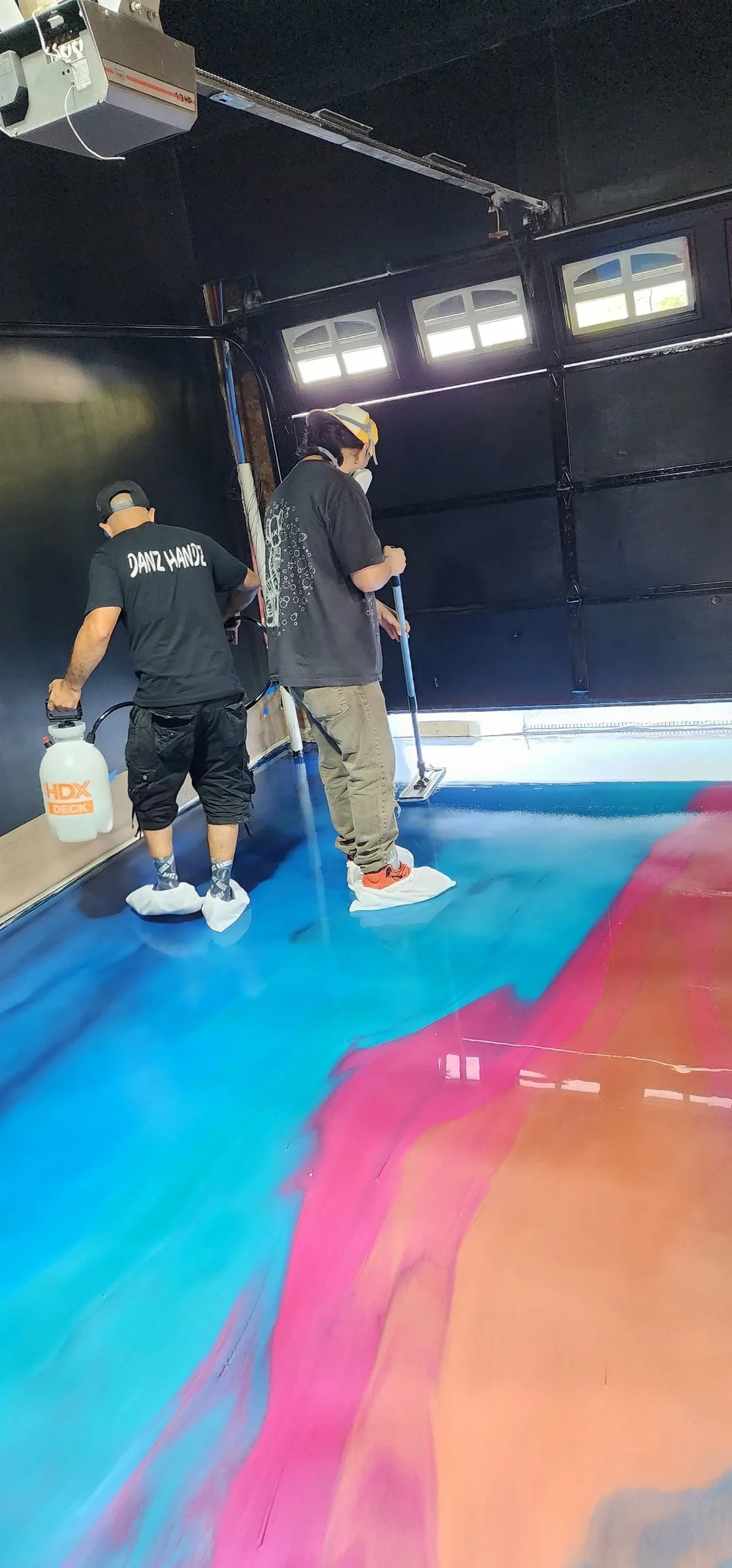
The whole clear layer is sanded to one uniform dull, which removes the fine scratches outright. Dust is vacuumed and wiped until a hand run across the floor comes up clean, and the new clear coat is poured wall to wall in a single session so no lap lines form.

Checking it with the same beam
After the cure, Danny puts the flashlight back on the floor in the same spots as the first visit. The owner sees the before and after under the light that exposed the problem, and chair glides go on before any furniture is carried back into the room.
More of Danny’s floors
Other jobs from the file, not all of them this service. See the gallery







Questions about scratched epoxy floor restoration
Can you buff the scratches out instead of recoating?
Light buffing can soften very fine marks for a while. On most epoxy floors, though, the scratches sit too deep in the clear layer for buffing to remove them, and sanding with a fresh topcoat is the repair that lasts. Danny looks at the floor first and tells you if your marks are light enough to leave alone.
Will the metallic pattern change?
No. The metallic look lives in the color layer, and restoration only sands and replaces the clear coat above it. The swirls, cells and depth stay as they were. The one exception is a scratch that cut down into the color, which Danny points out during the walk so you know before the work starts what can be hidden and what will still show.
How long is the room out of use?
Plan on the room being closed from the day sanding starts until the new topcoat has fully cured, and a little longer before heavy furniture goes back. The exact timing depends on the product and on conditions inside the house, so Danny gives you the schedule for your floor when he books the work.
Will a satin or matte topcoat show fewer scratches than gloss?
Usually, yes. A lower sheen scatters light, so fine drag marks blend into the surface instead of flashing when the light hits them. The color underneath looks a little softer through a satin clear, and a metallic gives up some of its depth. Danny can show a sample of each sheen over your color before the pour.
Can a scratched floor be restored if pets live in the house?
Yes. Pets just need somewhere else to stay while the room is sanded and while the new clear coat cures, since paw prints in a fresh topcoat are permanent. Keeping nails trimmed and laying a runner along the route a dog takes most often slows the next round of marks.
What causes a white haze inside some of the scratches?
Fine scratches scatter light and fill with dried cleaner and grit, which reads as a pale haze, especially on dark colors. Sanding takes the scratched surface and the residue off together. If the haze sits under the clear layer instead of in it, Danny looks for the cause before restoring, since that is a different problem.
Next to this on the list
Peeling, bubbling, chipped or faded coatings, patched or recoated, plus upkeep plans for floors that work hard.
- Blistered Epoxy Coating RepairRepair for blisters that rise under older epoxy floors, starting with what is lifting the coating before choosing a patch or a redo.
- Cracked Epoxy Flooring RepairCracks ground open, filled and recoated to match, with active cracks turned into proper joints so the line does not keep coming back.
- Chipped Epoxy Floor RepairImpact chips from tools, weights and shovels ground back to sound coating, filled and rebuilt, with flake or color matched to the floor around them.
- Delaminating Coating RepairPeeling and lifting coatings removed back to sound bond, the cause tracked down, and the slab ground and recoated so the failure does not repeat.
- Discolored Epoxy Floor RepairYellowed, tire-marked or stained epoxy floors cleaned, sanded and recoated, with the topcoat chosen around how much sun the room actually gets.
Jobs run about 60 miles out from the Cranford shop, from the Jersey shore and the Poconos to Long Island and Fairfield County. See every areaSee the gallery
Danz Handz
Danny Carrero, epoxy specialist
dhepoxy@gmail.com
Cranford, NJ. Mon to Sat, 8 to 6. Hablamos español.
Start with a visit
A short note about the space is enough. Danny calls back and books a walkthrough.