
Service bay floors built around lifts, drains and doors
A few winters of slush and road salt will break up a bay floor right at the door, and the concrete around the lift posts usually cracks next. Those are the spots Danny looks at first, along with the trench drains. Each one gets repaired before the coating goes over the bay.

How Danny approaches vehicle service bay flooring
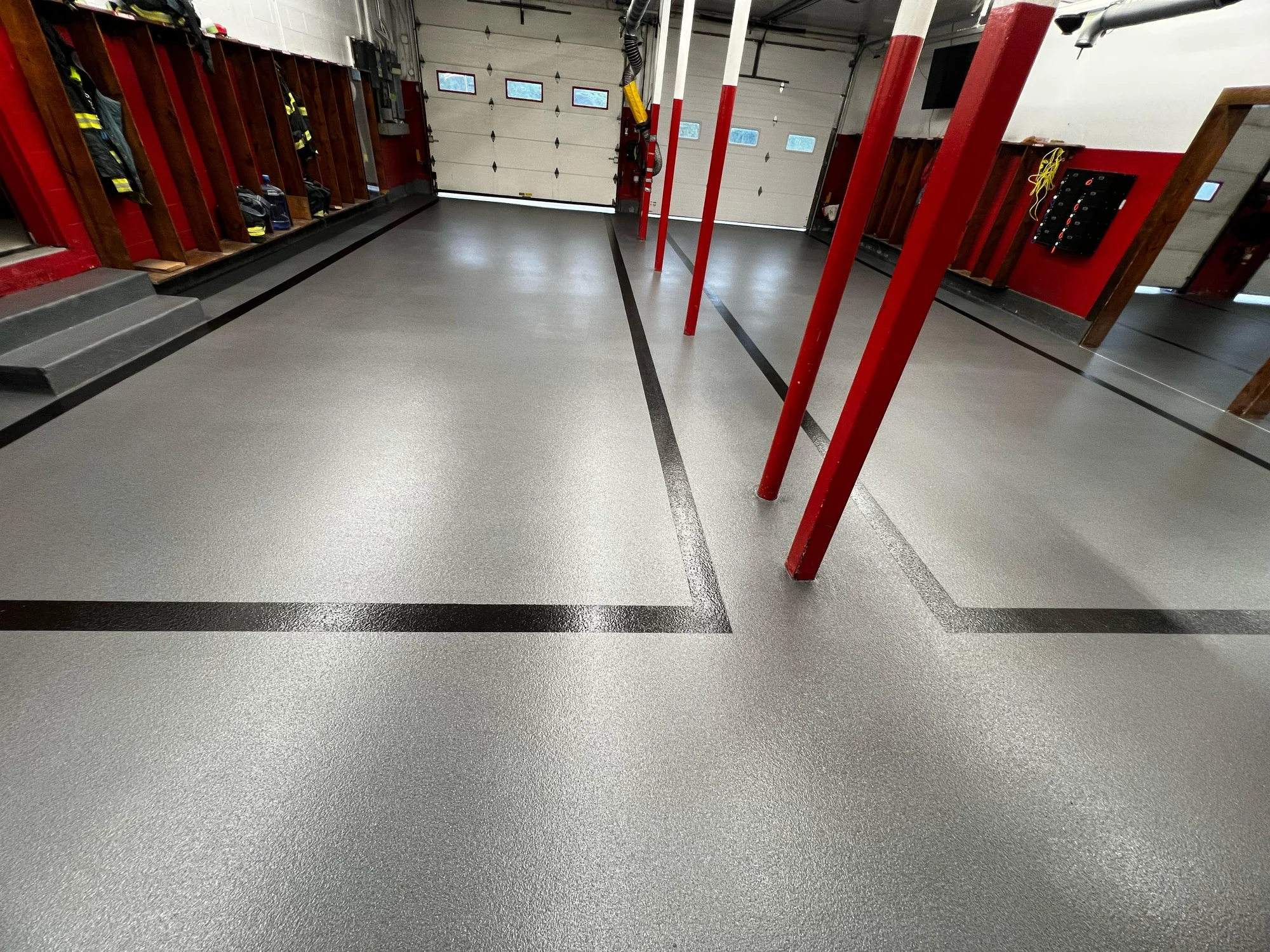
A service bay floor is a resin system laid over ground concrete, built to handle what each part of the bay sees. Around two-post and four-post lifts, the coating is worked carefully up to the anchors and baseplates. At floor and trench drains, it is brought to the drain edges so water runs off the surface. At the bay door, where slush, salt and grit come in on tires, the threshold is repaired and coated to take that. Danny chooses the system to the job’s requirements and the product data.
The bays are diamond ground, broken door edges and drain surrounds are repaired, and cracks are filled.
The weak spots in a bay are usually the door edge and the concrete around drains, and those need repair before any coating. Coating cannot fix a drain that sits too high, a slab that slopes the wrong way, or lift anchors that are loose in cracked concrete. Lifts may also need to be checked by the lift company after work around their anchors. Danny looks at each of these on the walk and tells the client which issues need attention first.
Danny walks each bay with the service manager, starting at the door and following the path a vehicle takes to the lift and back out. He checks the threshold, the drains and the concrete around every lift anchor. He looks at the space, the traffic and what gets spilled on it before recommending a system. The bays are diamond ground, broken door edges and drain surrounds are repaired, and cracks are filled. The pour is worked around lifts and brought to each drain. Bays cure closed, and the final walk follows the vehicle path again with the manager.
Bay floors fail first at the door, where winter rolls in on the tires.
Five stages, every time
A service bay is a path from the door to the lift and back. These steps follow that path, fixing the threshold, the drains and the lift anchors in the order a vehicle meets them.

Surveying the bays after winter
Danny looks at the bays with salt season in mind, checking for scaling just inside the doors and white residue where slush melted and dried. Those marks show how far road salt travels into each bay on the tires, and that sets how far the heavy prep runs.

Recording lift baseplates and anchors
Each lift’s baseplate and anchor bolts are measured and photographed, and cracked concrete around any anchor is flagged for the lift company. The plan sets how close the grinder can work to each plate and where hand tools take over.

Rebuilding the door apron
The broken strip of concrete at each overhead door is cut back to solid material and rebuilt with a patch made for vehicle traffic. Joints running in from the doorway are cleaned out and filled during the same pass.
Coating toward each trench drain
The slab is ground, and the coating goes down finished tight to every grate frame so water runs into the drain and not under the edge. Extra grit is broadcast just inside the door, where wet tires arrive first.
Driving the path once more
After the cure, a vehicle is driven from the door onto the lift and back out while Danny and the service manager watch the apron and the drain edges. The lift company can then check its anchors before the bay goes back into rotation.
More of Danny’s floors
Other jobs from the file, not all of them this service. See the gallery






Questions about vehicle service bay flooring
Can you coat around our lifts without removing them?
In most cases, yes. Danny grinds and coats up to lift baseplates and anchors, working by hand in tight spots. Some lift setups leave small areas that cannot be reached without removing the lift. He points those out on the walk. If the concrete around anchors is cracked, he will flag it so your lift company can check it.
What happens at the floor drains?
The coating is brought right to the edge of floor and trench drains so water flows into them instead of running under the floor. Drain surrounds that are broken get repaired first. Danny also checks how the floor slopes to each drain, since a coating follows the slab it sits on and will not change the slope.
Our door thresholds are crumbling. Can that be fixed?
Yes. Danny cuts back the broken concrete at the threshold and repairs it with a patch suited to vehicle traffic before coating. Thresholds take the most abuse in a bay because every vehicle crosses them with whatever is on its tires. A solid repair there is a big part of a floor that lasts.
Why does the concrete crack right around the lift posts?
A two-post lift puts the whole weight of a vehicle onto a few anchor bolts, and if the slab under the posts is thin or weak, it cracks around them. A coating does not fix that. Danny points out cracked anchor areas so your lift company or an engineer can decide whether the post needs a thicker footing.
Should the floor go in before or after new lifts are installed?
Before is easier. The bays can be coated wall to wall, and the lift installer then drills anchors through the cured floor and seals around each one. Coating after installation means working around baseplates and leaving the floor beneath them bare. Danny can coordinate dates with the lift installer so neither trade waits on the other.
Can the bays be marked with lift positions and walking lanes?
Yes. Lines showing where to stop a vehicle on the lift, plus a clear lane between bays for people on foot, can be laid in before the topcoat. They help new techs and keep tool carts out of the drive path. Danny lays them out from the lift positions measured at the start of the job.
Related floors
Auto, aviation, food, labs, schools, fitness, retail, parking and storage, matched to what actually hits the floor.
- Storage Unit Concrete Floor CoatingsCoated floors for self-storage units and corridors that keep dust off stored goods and get done around tenants and turnover.
- Facility Aisle CoatingsCoatings for warehouse and plant travel aisles only, stopping at the rack line so loaded racks stay put while the lanes get sealed.
- Auto Shop Epoxy FlooringResin floors for auto repair, tire and detail shops, built for the bays and good-looking enough to show off from the front counter.
- Mechanic Shop Floor CoatingsShop floors chosen for the techs on them: light enough to see under the car, smooth for creepers, textured where boots get oily.
- Aircraft Hangar Floor CoatingsLight-colored hangar floors that reflect light under the wings and make loose hardware easy to spot before it causes trouble.
Every county Danny covers, and every town in them, has its own page. See every areaSee the gallery
Danz Handz
Danny Carrero, epoxy specialist
dhepoxy@gmail.com
Cranford, NJ. Mon to Sat, 8 to 6. Hablamos español.
Start with a visit
Tell Danny what you are working with. He will call, then come look before anyone talks numbers.