
One continuous resin floor with no grout lines to scrub
Grout lines, plank edges and tile joints are where dirt settles, and a seamless resin floor has none of them because it pours as one continuous surface. In a kitchen, laundry, bathroom or salon, that means one floor that wipes clean, and Danny starts by checking what is under the old tile.


What seamless resin flooring really involves
A resin floor is mixed on site and poured in liquid form, so it flows into one surface wall to wall. There are no pieces to come loose and no gaps for water and grime. It can be epoxy or another resin, depending on the room. The look can be solid color, flake, metallic or a clear coat over concrete. Some installs carry the resin a short way up the wall as a cove base, which removes the corner where floor meets wall, the hardest spot to clean.
Then the slab is ground clean, cracks and old joints are filled, and slopes toward any floor drain are kept.
It suits concrete floors in kitchens, laundry rooms, bathrooms on a slab, salons, studios and back rooms of businesses. It needs a concrete base, so it does not go over wood framing or plywood. Existing tile usually has to come up first. Where a space falls under health or sanitation rules, the system has to be chosen to those requirements and the product data, and Danny works from them. Control joints in the slab may still need to be honored, which leaves a line.
Danny looks at the room for what the floor will face: water, drains, spills and the cleaning routine. He checks whether tile or other flooring has to come up and what is under it. Then the slab is ground clean, cracks and old joints are filled, and slopes toward any floor drain are kept. If you want a cove base, it is formed along the walls first. The resin goes down in layers so the floor and cove become one surface. He walks it with you and goes over cleaning and which products to skip.
No grout lines means nowhere for dirt to hide.
How the work runs
A continuous resin floor depends on what happens at the edges, the drains and the walls as much as across the open floor. These stages show how one unbroken surface gets built.


Lift the old tile
Any tile, grout and the thinset under them come up first, since the resin has to bond to concrete. The slab underneath is checked for cracks the tile was hiding and for any old shower pan or patch that needs attention.

Keep the slope to drains
Where a floor drain exists, the pitch toward it is measured and kept. Low spots that hold water are built up, and the drain rim is prepared so the resin can be finished tight to it without blocking flow.

Form the cove base
If you chose a cove, a curved fillet is built where the floor meets the wall, and resin is troweled up the wall to a straight top line. This is done before the main floor so the two can be coated together.

Pour wall to wall
The body coat goes down as one continuous pour across the room and up into the cove, with no stops that would leave a lap line. Control joints that must stay open are cut back in and sealed afterward.

Topcoat for wet cleaning
A topcoat suited to mopping and spills seals the surface, with grit added where wet feet will land. On the final walk, water is run to the drain to confirm it still flows, and Danny shows you how the cove wipes down.
More of Danny’s floors
Other jobs from the file, not all of them this service. See the gallery

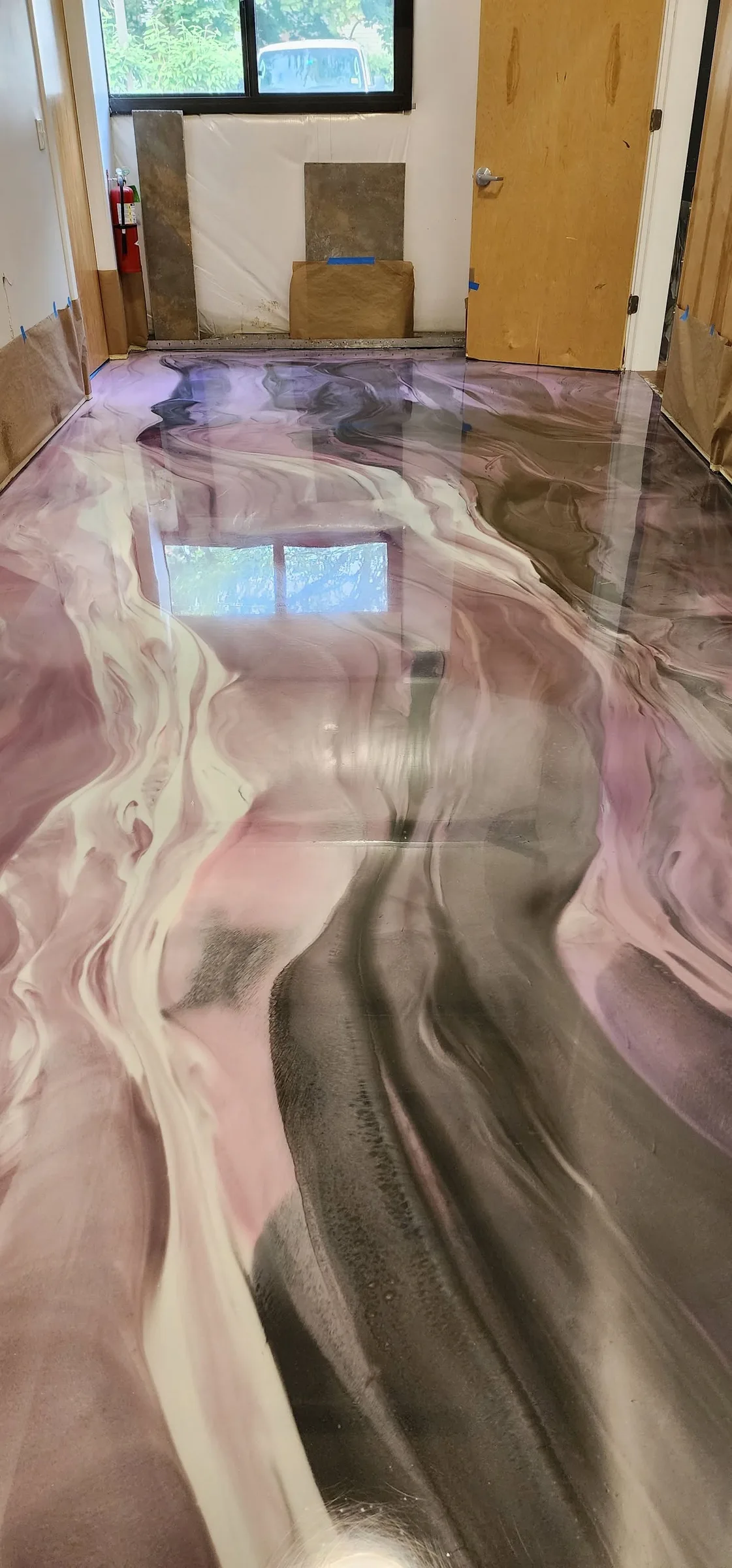






Questions about seamless resin flooring
Why are there no seams in a resin floor?
It goes down as a liquid and hardens into one surface across the whole room, so there are no tiles, planks or grout lines. The only lines left are control joints in the slab when they need to stay open, and Danny talks through those on the walk. With a cove base, even the wall corner disappears.
Can a poured resin floor go in a bathroom?
On a concrete slab, yes. It works well in a basement bathroom or a slab-level powder room where grout is a constant chore. It cannot go over wood subfloors, and any tile has to come up. Showers and wet areas need careful detailing, so Danny looks at the room before saying whether it suits.
Is it slippery?
A smooth glossy resin can be slick when wet, like any polished hard floor. In kitchens, laundry rooms and bathrooms, texture can be added to the topcoat for better footing. Danny talks through how much texture you want, since more grip also makes the floor a little harder to wipe clean.
What happens at the shower or tub?
The resin floor stops at the tub or shower base and is sealed to it with a compatible sealant, since those fixtures move slightly and need a flexible joint. Inside a tiled shower, a resin floor is a specialty detail that needs careful waterproofing. Danny looks at the layout and tells you where the floor should end.
Can a continuous floor run under kitchen cabinets?
It can if the floor goes in first, which gives a clean surface under everything and makes future changes easy. When cabinets are already in, the resin is finished to their toe kicks and sealed so water cannot get under the boxes. Danny checks the layout and suggests which approach fits the project.
How do you repair a continuous floor if it gets damaged?
Damage is cut out, refilled with the same resin system and blended into the surrounding surface. With no tiles to replace, the repair stays in the damaged spot. It can show a faint difference in sheen up close, and a full recoat later evens that out if it bothers you. Danny keeps a record of the colors used.
Next to this on the list
The core systems: residential, commercial and industrial epoxy, on new slabs and old ones, inside and out.
- Commercial Epoxy FlooringEpoxy for storefronts, showrooms, salons and offices, scheduled around your hours so the floor gets done without closing the doors for long.
- Industrial Epoxy FlooringEpoxy for warehouse, plant and shop floors, laid out in sections around your shifts, with striping built into the coating if you want it.
- Garage Epoxy FlooringGarage epoxy built for hot tires, road salt and dripped oil, ground and coated in layers so it stays bonded under the cars.
- Concrete Epoxy Floor CoatingsEpoxy coatings that start with the slab: moisture checked, old products ground off and cracks repaired so the coating bonds to sound concrete.
- Decorative Epoxy FlooringHand-poured metallic, flake, solid color and glitter epoxy floors, designed around the look you have in mind and the light in your room.
The shop is in Cranford. Most jobs are within an hour or so, across four states. See every areaSee the gallery
Danz Handz
Danny Carrero, epoxy specialist
dhepoxy@gmail.com
Cranford, NJ. Mon to Sat, 8 to 6. Hablamos español.
Book a walkthrough
A short note about the space is enough. Danny calls back and books a walkthrough.