
A floor in the exact color you have in mind
Standard color charts run to grays, tans and a few safe blues. Some rooms need a deep green, a warm white, or a shade that sits right with the cabinets. When the color is the whole point of the floor, Danny mixes toward it and works with the owner until the shade is right.


How Danny approaches custom color floor coatings
A custom color floor coating is a solid-color or tinted epoxy system mixed to a color the client picks, instead of one chosen from a short list. It can be a single quiet color across the room, a base color under flake, or the base in a metallic floor. Danny tints the material, which comes from Bulletproof Resins, and pours a sample so the client sees the actual color on a floor surface before the full job. Solid color floors are the calmest look he pours, and the least forgiving of the slab beneath.
On the walk he looks over the slab closely, since a solid color shows flaws.
It fits rooms where color matters and the slab is in good enough shape to carry it. A solid color shows everything: trowel marks, patched areas and dust all stand out more than on flake or metallic. Very light colors show tire marks in garages, and very dark ones show dust and scratches. Some colors are also hard to hold in strong sunlight over time. Danny talks through how a color will live in that room before anyone commits to it.
Danny starts with the color itself: a paint chip, a fabric, a photo, a cabinet door. He looks at the room’s light, then mixes and pours samples until the client is happy with the shade in that room. On the walk he looks over the slab closely, since a solid color shows flaws. On install, the floor is diamond ground, and cracks and patches are filled and leveled with extra care before the color coat goes down, followed by a clear topcoat. After the cure, he walks the floor with the client.
A solid color is the plainest floor, and it shows every flaw in the prep.
How the work runs
Choosing a color from scratch differs from matching one. The work explores a shade family, allows for how color grows across a whole floor, then holds it steady.


Narrowing the shade family
Many clients know the mood before the exact color: a deep green, a warm white, a muted blue. Danny starts wide with several shades in that family and uses the room’s walls, trim and furniture to narrow toward the one that sits right.

Allowing for the whole-floor effect
A color spread across an entire floor usually reads stronger than it does on a small chip, so Danny often steers a client a step lighter or softer than the chip they fell for. The tinted samples show that shift before anyone commits.

Checking where sunlight lands
Strong sun through windows or an open garage door can shift some colors over time. Danny asks where daylight falls and how long it stays, then uses the product data to pick pigments and a topcoat suited to that exposure.

Mixing the whole floor’s color at once
The full quantity of tinted material is mixed to one recipe and checked against the approved sample before work starts, so the color stays even from the first wall to the last. Running short halfway through is how two slightly different shades end up on one floor.

Color, clear, then a daylight look
After grinding and careful repairs, the color goes down in even coats and the clear follows. Once it cures, Danny and the client look at the floor at the time of day the room is used most, since that is when the color has to look right.
More of Danny’s floors
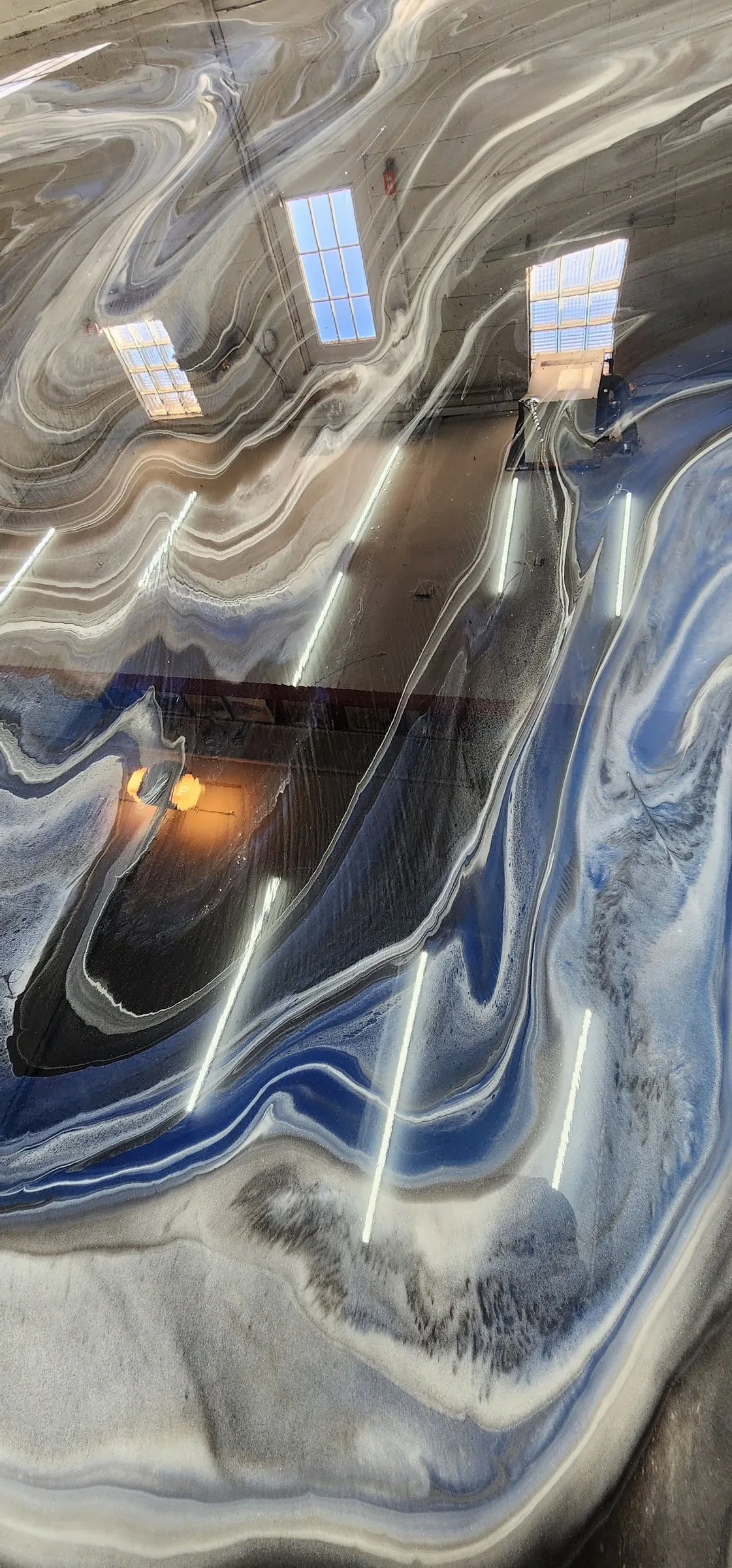
Other jobs from the file, not all of them this service. See the gallery







Questions about custom color floor coatings
Can you match any color?
Danny can mix a wide range of colors and match a reference closely, but every pigment has limits, and the color on a large floor can read differently than on a small chip. That is why he pours samples first. The client signs off on the sample in the room before the floor itself gets poured.
Will a solid color floor show imperfections?
More than flake or metallic will. A single flat color shows patched areas, low spots and dust more clearly, which is why Danny spends extra time on repairs and leveling for these floors. If the slab has a lot of history, he may suggest adding flake or choosing a mid-tone that hides more of it.
Can a custom color be used with flake or metallic?
Yes. The custom color can be the base under a flake broadcast, which shows through between the chips, or the base color in a metallic pour. Danny can also add Glitter ELEMENTZ to a solid color for some shimmer. The sample stage is where those combinations get worked out and approved.
Which custom colors are hardest to live with on a floor?
Very light colors show dirt and tire marks, very dark ones show dust and fine scratches, and saturated brights can feel loud across a whole room. Mid-tones with a little gray or warmth in them are the easiest. Danny talks through how each candidate will look on an ordinary, lived-in day.
Can a custom color be matched again for a repair later?
A repair is easiest when the original tint recipe and product are known, so keep the details Danny leaves after the job. Even with the recipe, a patch can look slightly fresher beside a floor that has aged, so repairs often run to a natural edge such as a doorway.
Do custom colors work in a garage that sees cars every day?
Yes, with a little thought. Hot tires can leave marks that show most on pale colors, and very dark floors show dust and salt residue. A mid-tone custom color under a good clear coat handles daily parking well. Danny asks how the garage is used before settling the shade.
Next to this on the list
Color matching, sample boards, branded floors and epoxy countertops. Bring the idea and Danny builds the sample.
- Luxury Garage FlooringHigh-end garage floors, mostly metallic epoxy, poured for collector cars and finished garages where the floor should match the rest of the house.
- Designer Basement Floor CoatingsDecorative basement floors in soft metallics, solid colors and flake, poured over a dry slab so the lower level looks like part of the house.
- Custom Workshop Floor FinishesShop floor finishes picked for the work: light colors to find dropped parts, flake for sawdust and tougher topcoats for rolling tool chests.
- Retail Branding Floor InlaysBrand details inlaid into a retail floor at the entry, the register and feature displays, set in the coating and sealed under a clear coat.
- Decorative Resin Flooring for OfficesDecorative resin floors for offices, studios and reception areas, quieter in look than a garage floor and easy to mop under desks and chairs.
From Union County out to the Lehigh Valley, Long Island and Fairfield County, the work is all within about 60 miles of Cranford. See every areaSee the galleryRead: Glitter in Epoxy Floors: How Much Is Enough
Danz Handz
Danny Carrero, epoxy specialist
dhepoxy@gmail.com
Cranford, NJ. Mon to Sat, 8 to 6. Hablamos español.
Schedule a look at your floor
A short note about the space is enough. Danny calls back and books a walkthrough.