
Epoxy floors for offices and open workspaces
The wear in an office follows people: a path to the break room, a dull ring around every desk chair. Danny lifts a corner of carpet on the first visit to see what the slab underneath looks like. What goes back down is a hard poured floor, usually a quiet gray or warm neutral that hides scuffs.

The short version of office epoxy flooring
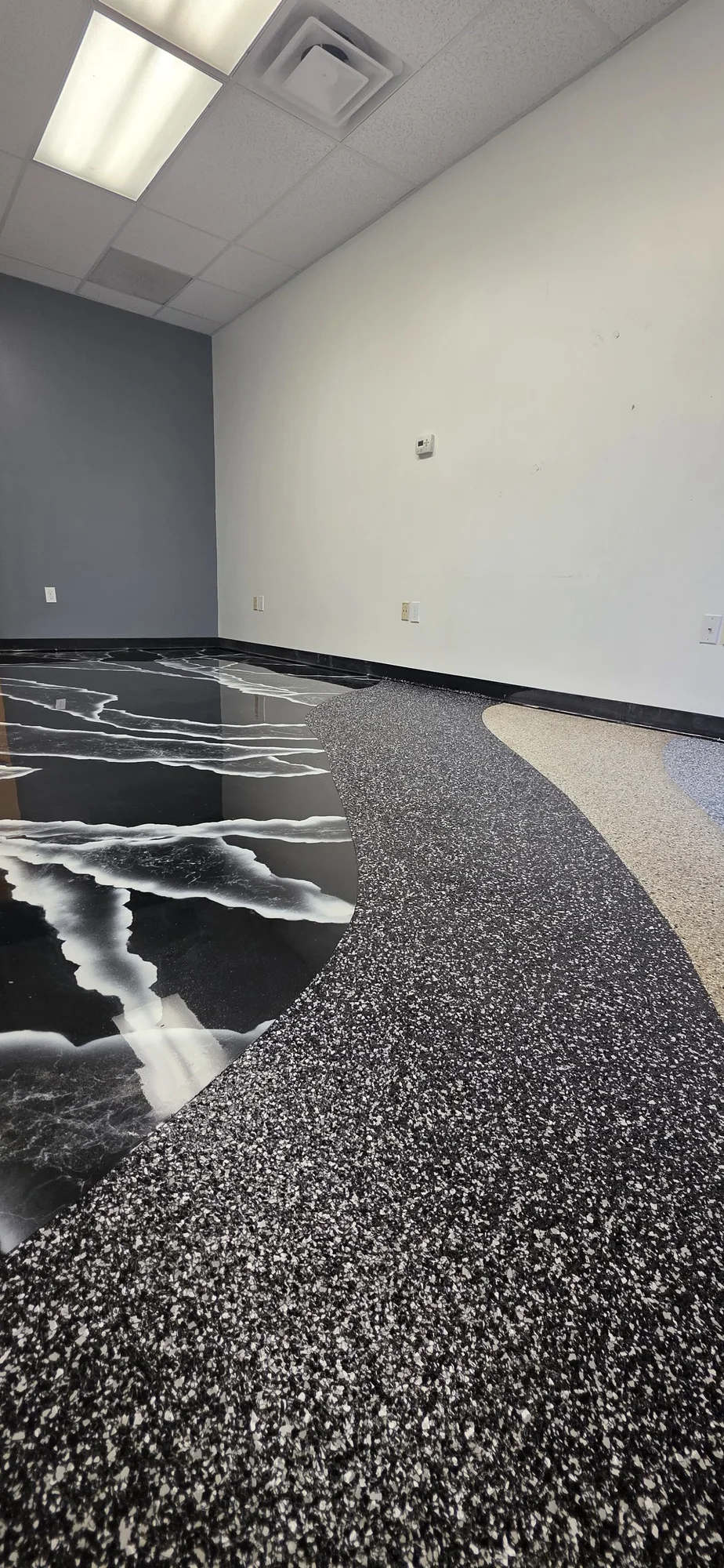
An office epoxy floor is a resin coating poured over the concrete that sits under the old carpet or tile. It can be a solid color, a flake blend, or a soft metallic that reads as polished stone without being loud. Most offices go with grays, warm neutrals or a darker tone that hides scuffs. The finished surface is hard and continuous, so chair wheels roll freely and there are no carpet seams to fray or tiles to pop loose near desks or under the conference table.
An office epoxy floor is a resin coating poured over the concrete that sits under the old carpet or tile.
It suits offices on a slab where the floor sees rolling chairs and steady foot traffic: tech and design studios, contractor offices, warehouses with an office up front. The honest drawback is sound. A hard floor carries footsteps and voices more than carpet does, so a large open room may need rugs or acoustic panels to stay comfortable. Offices on a raised access floor or over wood framing are usually the wrong fit, and Danny will tell you that before anything gets planned.
The first visit is about how the office actually works. Danny walks it with the manager, notes where desks sit and where people cut across the room, then lifts a corner of carpet or tile to see what the slab looks like underneath. Old adhesive gets diamond ground off, cracks and dips get repaired, and the floor gets vacuumed clean. Offices often want the work timed around a slow week or a move, so the pour is scheduled once the furniture plan is set. After the cure, Danny walks the space again with the manager before the desks roll back in. Most of what goes down comes from Bulletproof Resins, his material partner, picked to suit the room and how it gets used.
Rolling chairs wear out carpet first, so office floors fail under the desks before anywhere else.
How Danny does the job
Every floor goes through the same five stages. What changes is how much each one takes, and that gets settled at the walkthrough.

Walk the space
First visit is a look at the concrete and a talk about the look you want and how hard the floor works.

Prep the concrete
A grinder and a vacuum take the slab down to fresh concrete so nothing sits between the floor and the coating.

Fix what is underneath
Anything that would telegraph through the coating gets filled, sanded and checked.

Lay it down
Base coat, color or broadcast, then the topcoat, laid down by hand in the order the system calls for.
Cure and the final walk
Once the floor has cured, Danny walks it with you and goes over care and cleaning.
More of Danny’s floors
Other jobs from the file, not all of them this service. See the gallery








Questions about office epoxy flooring
Can epoxy go over our office carpet or vinyl tile?
No. Carpet comes up entirely, and vinyl tile comes up with its adhesive, because the coating has to bond to bare, ground concrete. The good news is that the slab under old office flooring is often in decent shape. Danny checks it during his first visit by pulling back a corner, so you know what you are working with before you plan around it.
Will rolling chairs scratch the floor?
Chair casters are one of the reasons offices pick a coated floor, since there are no seams or carpet pile for them to catch on. Over the years, the topcoat will show light wear where chairs roll most. Soft rubber casters help, and the topcoat can be refreshed later without redoing the whole floor.
Can the floor match our brand colors?
Within reason, yes. Solid colors can be matched closely, and a metallic floor can carry a brand color as an accent through a neutral base. Danny usually recommends keeping strong brand colors for walls and signage and letting the floor sit a step quieter, but the call is yours, and he can mix a sample for you to look at in the room.
How long before I can use the floor?
It depends on the system and the temperature. Danny gives you the times for your floor before the job starts so you can plan around them.
Do you teach epoxy too?
He has run hands-on epoxy classes in Cranford for the last three years. The training page covers what a class goes through.
Why does the concrete get ground first?
A coating holds onto concrete by getting into the top of it. A smooth or sealed slab gives it nothing to grab, so grinding comes first and the dust gets vacuumed off.
Other commercial work
Salons, barbershops, showrooms, restaurants, offices, gyms and clinics, worked around your hours.
- Commercial Laundry FlooringSealed laundry floors that handle water, detergent and machine traffic, poured around or under washers with texture where floors get wet.
- Commercial Storage Room FlooringSealed storage room and stockroom floors that stop concrete dust, brighten the room and roll easily under carts and hand trucks.
- Apartment Common-Area Floor CoatingsCoated floors for apartment laundry rooms, mail rooms, storage and trash rooms, scheduled room by room so residents keep access.
- Property Management Floor Coating ServicesFloor coating for property managers, with one contact walking every building and consistent colors across laundry rooms, storage and lobbies.
- Tenant Improvement FlooringCoated concrete floors for tenant build-outs, timed into the construction schedule between the messy trades and move-in day.
Based in Cranford, NJ. Danny takes work across New Jersey, the five boroughs, Long Island, Westchester and Rockland, Fairfield County and Bucks County. See every areaSee the gallery
Danz Handz
Danny Carrero, epoxy specialist
dhepoxy@gmail.com
Cranford, NJ. Mon to Sat, 8 to 6. Hablamos español.
Tell Danny about the floor
Tell Danny about the space. He calls you back, comes out, looks at the concrete and talks it through before anything gets decided.