
Resin floors for school hallways and cafeterias
A cafeteria takes spilled trays and tables dragged into rows every lunch, and the hallway outside takes the whole school between bells. Those are the floors where tile tends to crack first. Danny looks at them along with the locker rooms and shop classrooms, and lays the work out across summer and the longer holiday breaks.
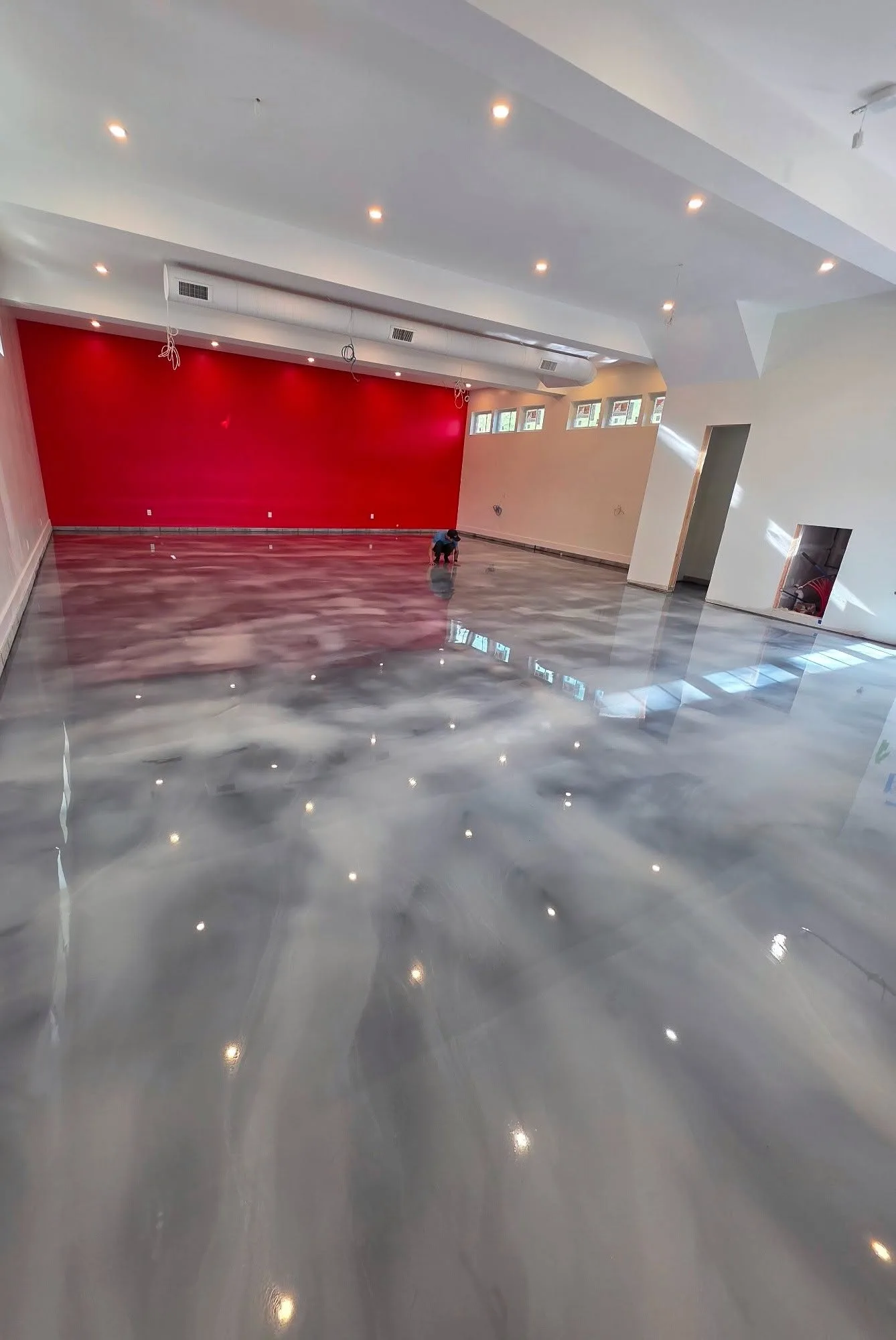

School Floor Coatings, from Danny’s side of the job
A school floor coating is a resin system poured over the concrete slab once it has been diamond ground and repaired. It cures into one continuous surface, so there are no grout lines in a cafeteria to hold spilled milk and no tile edges in a hallway for a cart wheel to catch. A solid base with a contrasting band can mark a hallway’s walking lane, and a flake broadcast hides scuffs and crumbs between cleanings. Danny sees how students move through a building, and what lands on each floor, before he recommends a system.
Danny sees how students move through a building, and what lands on each floor, before he recommends a system.
It fits slab-on-grade spaces that take heavy foot traffic and a lot of mopping: corridors, cafeterias, locker rooms, art rooms and technical shop classrooms. It is the wrong choice for a wood gym court, which needs its own sports flooring, and for upper floors framed in wood that flex underfoot. Classrooms that want a softer, quieter floor often keep carpet or resilient tile. Where a district has written flooring requirements, the system is chosen to those requirements and the manufacturer’s product data, and Danny reads them before he plans anything.
Most school work happens over summer break, so the first walk usually takes place in spring while the building is still in use. Danny walks the corridors and cafeteria with the facilities director, looks at how students move between classes, finds the cracked tile and the worn spots in front of the lunch line, and checks the slab under any flooring that has to come up. Once school lets out, the floor gets diamond ground, cracks and low spots get repaired, and the coating is poured in sections so the custodial crew can keep working elsewhere. After the cure, Danny does a final walk with the director before furniture and lunch tables come back. Danny pours with Bulletproof Resins material, mixed in small batches on the job so nothing sits in the bucket too long.
A school floor gets one long break a year, and the work has to fit inside it.
How Danny does the job
Every floor goes through the same five stages. What changes is how much each one takes, and that gets settled at the walkthrough.


Walk the space
Danny comes out, looks at the slab, the cracks and the moisture, and asks how the room gets used.

Prep the concrete
Prep is grinding and cleaning, done until the concrete is ready to take a coating, not before.

Fix what is underneath
Anything that would telegraph through the coating gets filled, sanded and checked.

Lay it down
Material gets mixed fresh and worked across the floor while it is still workable.

Cure and the final walk
After it cures, you and Danny walk the finished floor before anyone calls it done.
More of Danny’s floors
Other jobs from the file, not all of them this service. See the gallery







Questions about school floor coatings
Can the work be done while school is in session?
Small areas sometimes can, over a long weekend or a holiday break, if the room can stay closed through the pour and the cure. Hallways and cafeterias are usually summer jobs, because closing them during the year moves too many students. Danny looks at the building and the calendar together and lays out which rooms fit which break.
Does the coating work in a school shop or art room?
Often, yes. Shop classrooms see dropped tools, sawdust and finishes, and art rooms see paint, clay and water, all of which clean up more easily from a continuous coated surface than from bare concrete or tile. Danny asks what each room is actually used for, and what gets spilled there, before he suggests a system and a texture.
What happens to the old tile in the hallways?
It comes up before the coating goes down, along with its adhesive, because the resin has to bond to ground, bare concrete. Some older school tile can contain materials that need special handling, so the district should confirm what the tile is before anyone disturbs it. Once it is gone, Danny grinds the slab and repairs whatever the tile was hiding.
What should I have ready for the walkthrough?
Clear enough of the floor for Danny to see the concrete, and have a rough idea of the look you want. Photos of floors you like help.
What happens if the slab has cracks?
Cracks and chips get filled and ground flush before the coating goes down. Danny will tell you at the walkthrough if a crack is likely to move and what that means for the floor.
Do you come out and look before anything gets decided?
Yes. Danny walks the space, checks the concrete and talks through what you want before anything is ordered or scheduled. Call (908) 577-7104 or send the form and he will set a time.
Other industries work
Auto, aviation, food, labs, schools, fitness, retail, parking and storage, matched to what actually hits the floor.
- Grow Room Floor CoatingsLight, coved resin floors for individual grow rooms, recoated in the window between harvest and the next planting.
- ESD FlooringStatic-dissipative resin floors tied to building ground, installed to your facility’s static-control plan for electronics handling areas.
- Electronics Manufacturing Floor CoatingsElectronics plant floors laid out from the floor plan, with static-control systems where parts are handled and general coatings elsewhere.
- Technical Room Floor CoatingsSealed resin floors for server, telecom, UPS and battery rooms, ground and coated in sections around equipment that keeps running.
- Static-Control FlooringResin floors tied to ground that reduce static buildup in print shops, packaging lines and offices where people keep getting shocked.
Danny works out of Cranford, NJ and covers about 60 miles: North and Central Jersey, the city and Long Island, the Hudson Valley counties, Fairfield County and eastern Pennsylvania. See every areaSee the gallery
Danz Handz
Danny Carrero, epoxy specialist
dhepoxy@gmail.com
Cranford, NJ. Mon to Sat, 8 to 6. Hablamos español.
Book a walkthrough
Tell Danny about the space. He calls you back, comes out, looks at the concrete and talks it through before anything gets decided.