
Metallic, flake and solid floors for Oreland
More of the homes in Oreland were built in the 1950s than in any other decade. Garage and basement slabs from those decades often carry old paint or tile that gets ground off first.
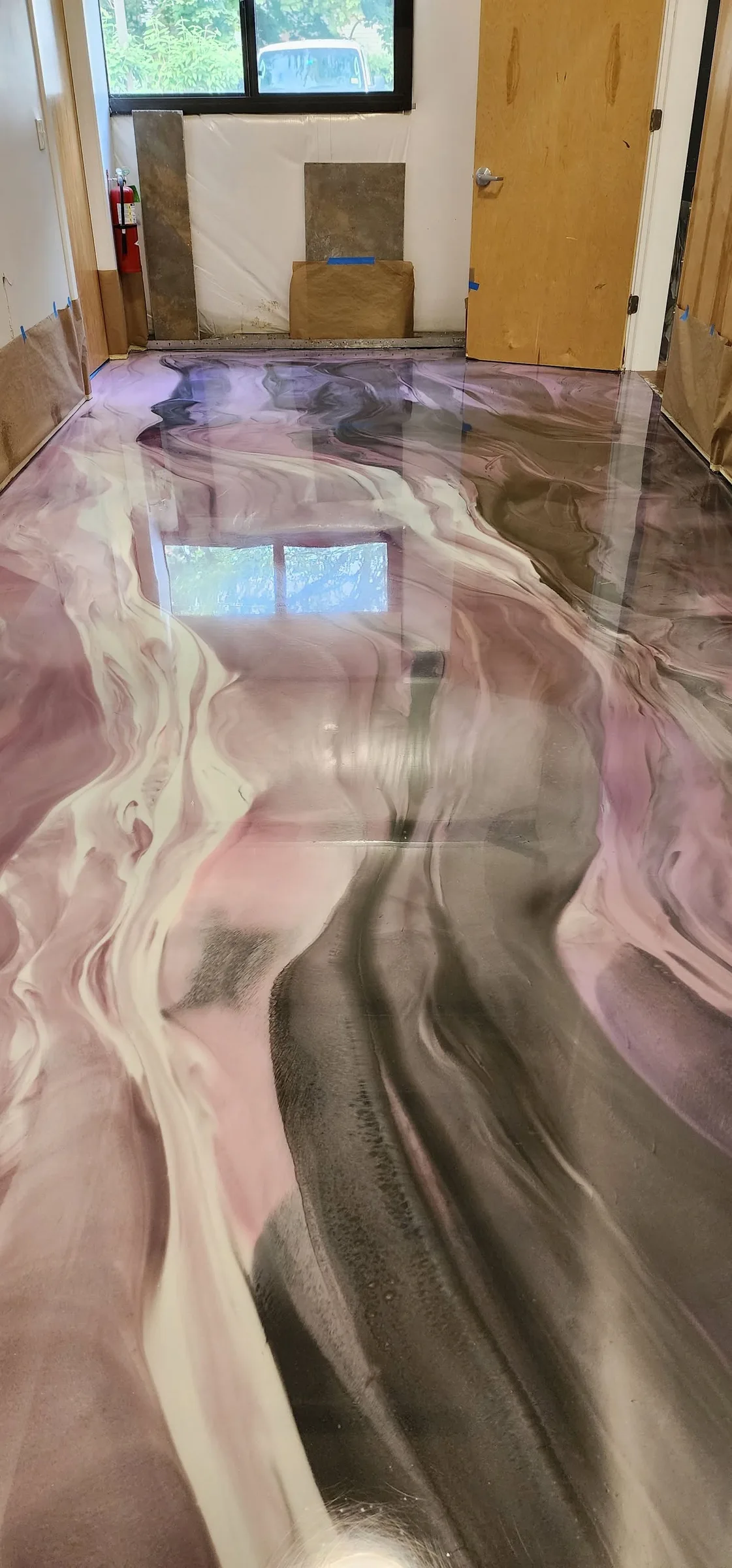
Oreland’s 1950s houses
Oreland is a community in Springfield Township, Montgomery County, Pennsylvania.
The Census counts about 2,287 homes in Oreland, with a median build year of 1953.
Sources: US Census Bureau, American Community Survey 2024 5-year survey, for Oreland, PA; FEMA National Flood Insurance Program claims, 1978 to 2026, for Springfield Township.
Next stops from Oreland
- Glenside1.7 mi southeast
- Arcadia University1.8 mi southeast
- Fort Washington1.9 mi north
- Wyncote2.4 mi southeast
- Roslyn2.5 mi northeast
- Jenkintown3 mi southeast
Every town in Montgomery County is on the Montgomery County page.
What Oreland’s housing means for the floor
Postwar slabs were often poured right on the soil with no plastic sheet underneath, so moisture is the first thing Danny checks in a house from those years.
Where the typical home went up near 1953, many basements date from the era of block walls and a thin floor slab with a single drain in the middle. Hairline cracks near the walls and around that drain are normal at this age. Danny opens and fills the ones that matter, leaves the stable ones to be covered, and plans the pour so the floor still falls toward the drain the way it was built to.
Floors for Oreland’s 1950s houses
All 380 services- Concrete Moisture TestingMeasuring the moisture in a slab before the floor is chosen, then matching the primer and system to the reading and the product data.
- Garage Floor Coating RemovalGrinding failed paint, DIY kits and old epoxy off garage floors down to clean concrete, ready for a new system to bond.
- Basement Epoxy FlooringBasement floors with personality, often a metallic under recessed lights, poured on a dry slab for bars, media rooms and playrooms.
- Solid-Color Garage Floor CoatingSolid-color garage coatings in one even color, ground flush for a clean look, with optional stall lines and grit for traction.
- Outdoor Entertainment Area CoatingsOutdoor coatings for grilling, bar and seating areas, with zones laid out by use and grease ground out before the pour.
- Color-Flake Floor CoatingsFlake floors where the chip blend and base color are chosen to sit right with your walls, cabinets, siding or brand colors.
Questions about Oreland
How far is Oreland from Danny’s shop?
About 59 miles southwest of Cranford. Glenside is the closest town to it on Danny’s list.
How old are the houses in Oreland?
The Census puts the median build year in Oreland at 1953. By decade built: before 1940, 12%; the 1940s, 27%; the 1950s, 37%; the 1980s, 6%.
What do FEMA’s flood records show for Springfield Township?
FEMA’s flood insurance records show 184 claims from Springfield Township since 1978, the most after Tropical Storm Lee in 2011 (19). FEMA files Oreland under Springfield Township, so the count covers all of Springfield Township, not Oreland alone.
What kind of housing is in Oreland?
By the Census count for Oreland: 87% single-family detached houses, 6% townhouses and attached homes, 7% two- to four-family buildings. 91% of occupied homes are lived in by their owners.
Can Danny match a floor I saw online?
Often he can get close, and sometimes he will suggest a change that suits your room better. Bring the photos to the walkthrough. Metallic floors are poured by hand, so no two come out exactly alike, and Danny is straight with you about that. He works out what you liked about the picture and builds the floor around it.
Do you pour epoxy countertops too?
Yes. Epoxy countertops are part of what Danny does, and they get the same attention to color and movement as his metallic floors. The design is worked out first, with samples, so the finished top looks like what you pictured. Call to describe the counter and the room it is in, and he will set a time to see it.
What if my floor already has paint or an old coating on it?
It comes off. Danny grinds old paint, failed coatings, tile glue and sealers down to bare concrete, because the new floor has to bond to the slab itself. On the walk he checks how much is there and whether any of it hides damage. Mention anything you know about the floor’s history, since it can change the prep.
What happens at the walkthrough?
Danny walks the slab with you and looks for cracks, old coatings, oil stains, damp spots and anything else that will change the prep. Then he asks how the room gets used and what look you have in mind, and he shows samples in that room’s light. You come away knowing which system he recommends and why.
Should the garage and the basement get the same floor?
Usually not. A garage takes hot tires, salt, oil and grit, so a flake floor with texture tends to suit it. A basement is more of a room, where a metallic or a solid color can carry the look. Basements also bring moisture into the picture, so Danny checks that slab separately and recommends what fits each space.
How do we settle on colors for a metallic floor?
Danny starts with the picture in your head, then holds real samples next to your walls, cabinets and lighting. Metallic floors move, so he explains how the color will flow and where it tends to gather. His job is to get into your vision and keep it from heading in ten directions at once. Once the design is set, the pour follows that plan.
What material does Danny use?
He partners with Bulletproof Resins for his material and picks the specific system for each floor after the walkthrough. A garage that sees salt and hot tires gets a different build from a basement or a showroom. He explains what he is putting down and why, so you know what is going on your floor before the pour starts.
Danz Handz
Danny Carrero, epoxy specialist
dhepoxy@gmail.com
Cranford, NJ. Mon to Sat, 8 to 6. Hablamos español.
Book a walkthrough
Tell Danny about the floor. He calls back and comes out from Cranford, 59 miles southwest, to look at it.