
Patching holes and gouges in a coated floor
Holes from old shelving bolts, a machine anchor or a lift post, and gouges deep enough to reach the concrete itself, go past the coating. Those spots get filled and leveled with the floor around them first. Only then can the patch be coated and blended so the floor reads flat and whole again.


The short version of epoxy floor patching
Patching fills damage that reaches into the slab. Anchor holes, gouges, broken concrete around a drain or a post, and low spots where something heavy came down all get cleaned out to sound concrete, filled with a repair material and leveled flush with the floor. Once the patch has set, it is ground smooth and coated so it carries the same color, flake and topcoat as the floor around it. The patch has to be solid before the coating goes over it, because a soft fill shows through.
Once the patch has set, it is ground smooth and coated so it carries the same color, flake and topcoat as the floor around it.
It fits floors where the damage is in a few defined spots and the coating elsewhere is well bonded. It does not fix a slab that is crumbling over a wide area, which is a resurfacing job, or concrete that is cracking from movement below. Matching follows the usual rule: flake hides a patch best, a solid color comes close, and a metallic shows the edges more. Danny will point out the spots where a patch will be visible.
Danny walks the floor and looks at each hole or gouge, checking how deep it goes and whether the concrete around it is sound or breaking up. He notes old anchors that are still in the floor, since those have to be cut out flush or removed before anything gets filled. Each spot is ground out and cleaned, the repair material goes in, and the patch is leveled and ground flush once it has set. Then the patched areas are coated to match, with flake broadcast where the floor has it. After the cure, he walks the floor again with you and checks each patch underfoot and by eye.
A patch only looks right once it is level with the floor around it.
From bare slab to finished floor
Patching deals with holes that go into the concrete, so each stage below starts from the slab and works up through the coating, never the other way around.
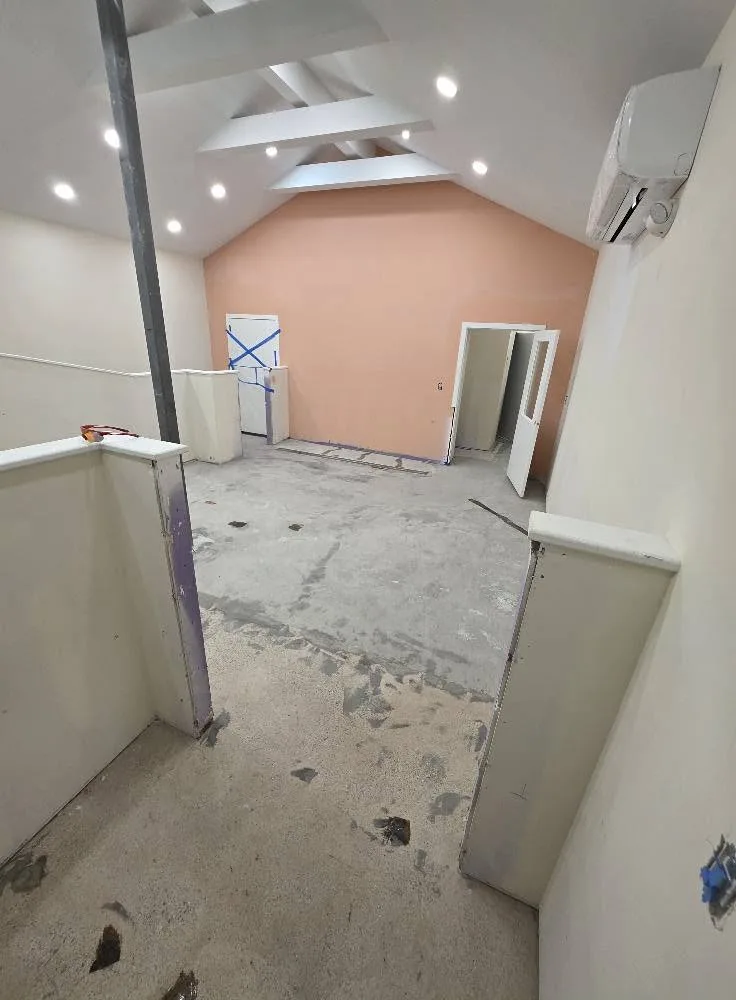

Probing depth with a screwdriver
Danny probes each hole and gouge with a screwdriver to feel how deep it goes and whether the concrete around it is firm or crumbles. He also feels for steel left in old anchor holes, since a stub of bolt below the surface changes how the hole gets handled.

Clearing anchors from the slab
Anchors still in the floor are cut with an abrasive wheel or pulled where they come free. Rusting steel swells as it corrodes, so Danny cuts far enough below the surface that the fill covers the metal completely before the hole is packed.

Squaring and cleaning the cavities
Ragged gouges are cut into clean shapes with straight edges, and loose concrete is chipped out until only hard material remains. Dust is vacuumed from the bottom of every cavity, because a fill sitting on powder lets go long before one bonded to clean, open concrete.

Packing fill flush to the floor
Deep holes are filled in more than one pass so the material does not slump as it hardens. Each patch is left slightly high, ground flush once set and checked with a straightedge laid across it, so the coating does not trace a dip or a hump.

Coating and a heel test
The patches get the floor’s color, flake and topcoat, carried past the edges of each one. After the cure, Danny and the owner walk over every patch and drag a heel across its edges, the quickest way to feel any lip the eye might miss.
More of Danny’s floors
Other jobs from the file, not all of them this service. See the gallery







Questions about epoxy floor patching
Can holes from removed shelving be filled?
Yes. Anchor holes are some of the most common patching jobs. Any anchor left in the floor is cut flush or pulled, the hole is cleaned and filled, and the patch is ground level and coated to match. On a flake floor, the filled spots usually disappear into the pattern once the topcoat goes over them.
What is the difference between patching and a touch-up?
A touch-up fixes the coating’s surface, like a scuff or a shallow nick. Patching fills damage that goes into the concrete, such as a gouge or a bolt hole, and rebuilds the slab to level before the coating goes back on. Danny tells you which your marks need when he sees them.
Will a patched area be as strong as the rest of the floor?
A patch done on clean, sound concrete with the right repair material bonds well and wears with the floor. Where the concrete around a hole is already breaking up, the patch is only as solid as what it is attached to, so Danny grinds back to firm concrete first and will say if an area needs more than a patch.
Can gouges from a dragged appliance be patched?
Yes. A refrigerator or washer slid across a coated floor can plow a groove through the coating into the concrete. The groove is cleaned, filled and ground flush along its full length, then coated to match. Long straight gouges are easier to see than round holes, so on a metallic or dark floor Danny may suggest recoating the section around it.
Do patches change color over time compared with the rest of the floor?
The patch itself is buried under the same color and clear as the floor, so it ages along with everything around it. Where the new topcoat meets the old, the sheen can differ for a while. Foot traffic tends to even that out, and a later topcoat refresh across the room closes the gap.
Can patching fix a broken edge around a floor drain?
Usually. Concrete around a drain often breaks down from water and traffic, and the broken rim is cut back to solid concrete, rebuilt and shaped so water still runs into the drain. The grate has to come out for the work, and if the drain body itself is cracked, a plumber looks at it first.
More from the repair section
Peeling, bubbling, chipped or faded coatings, patched or recoated, plus upkeep plans for floors that work hard.
- Epoxy Floor Deep CleaningCleaner haze, tire marks and ground-in grime stripped off a dull epoxy floor, so you see what it really looks like before deciding on repairs.
- Floor Coating Inspection ServicesA hands-on walk of an existing coated floor, with a plain read on what is sound, what is failing and what each part needs.
- Protective Topcoat RenewalA fresh clear wear layer poured over a sound coated floor before traffic reaches the color, with the option to change the sheen.
- Scheduled Commercial Floor MaintenanceFloor maintenance visits set on the business calendar, with small fixes handled on the spot and bigger work booked for planned closures.
- Epoxy Floor Replacement and ReinstallationFailed epoxy floors ground off to bare concrete and replaced from the base up, with the chance to switch to flake or a high-end metallic.
From Union County out to the Lehigh Valley, Long Island and Fairfield County, the work is all within about 60 miles of Cranford. See every areaSee the gallery
Danz Handz
Danny Carrero, epoxy specialist
dhepoxy@gmail.com
Cranford, NJ. Mon to Sat, 8 to 6. Hablamos español.
Start with a visit
Send a few lines about the room and the look you want. Danny will call and set up a time to see it.