
A one of one metallic floor for a Garwood house
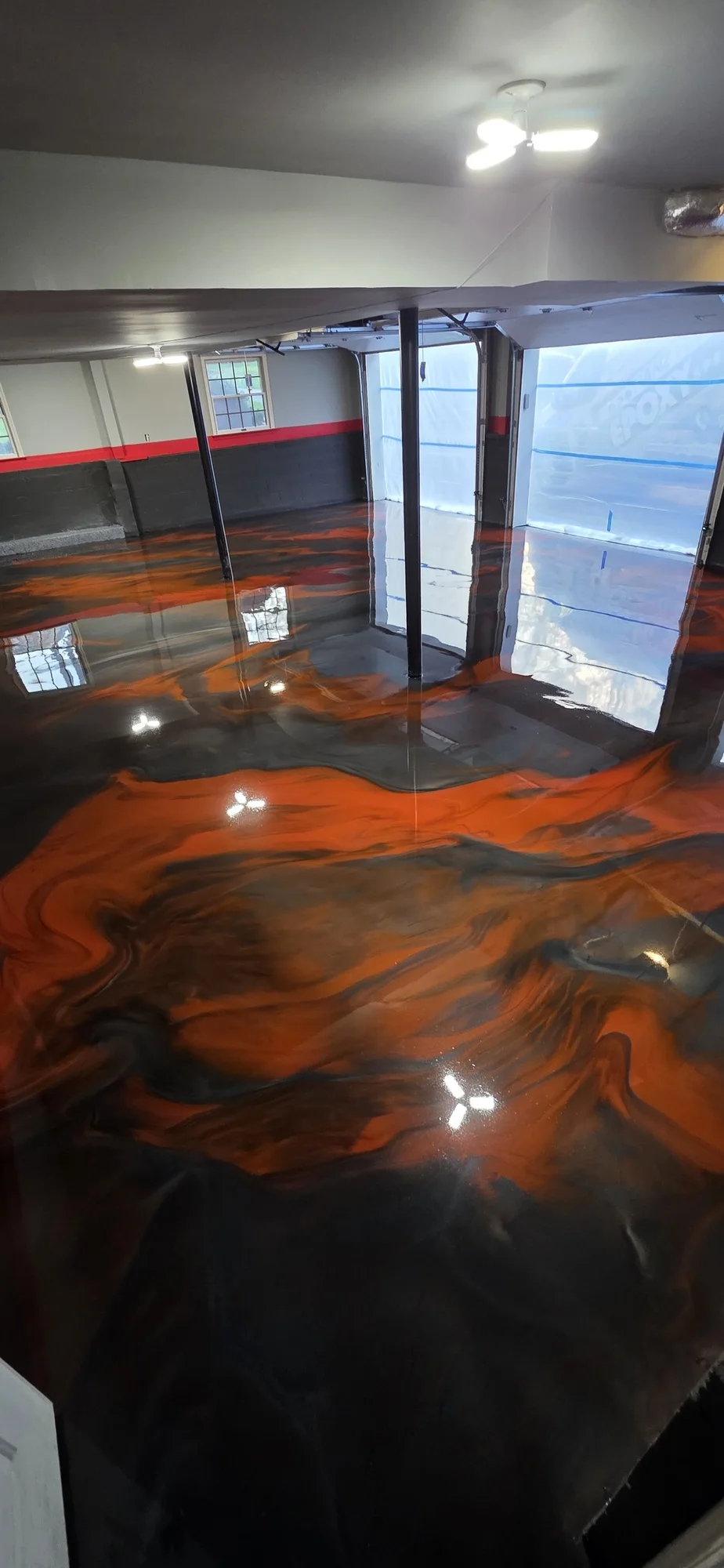
A metallic floor is the closest thing epoxy has to a painting, and no two pour the same way. In a Garwood house, that usually means a basement rec room, a garage turned lounge or a living space sitting on concrete. Danny asks what you picture first, brings samples into the room’s own light, and settles the color plan before anything is mixed. Book a walkthrough and he will look at the slab first.

Designing the pour around the room you have
Metallic epoxy carries a pigment with fine reflective particles in it. While the resin is still wet, those particles drift, settle and catch on each other, which is where the depth and movement come from. Danny can steer that movement with how he lays the color down and how he works it, but the floor always keeps a little of its own say. That is the reason every one is one of one, and the reason the planning matters as much as the pour.
Picking color takes up most of the first visit. Bring photos of floors you like, a paint chip from the trim, even a picture of a car or a stone you keep coming back to. Danny holds real samples against your walls and cabinets in daylight and again with the lamps on, because a copper that glows at noon can turn muddy under warm bulbs. He also shows where pigment tends to gather, along edges and at the low spots of a slab.
The best metallic floors look planned from the doorway and surprising once you are standing in the middle of them.
The goal is to get inside your idea of the room, settle it, and then let you step back while the work happens. Some people want one calm color with a slow drift through it. Others want black with gold veins, or a marble look with white running through charcoal. A few want something nobody has asked for yet, and those are the fun ones. Danny draws up the plan for each floor and is on site when it goes down, and the full range of looks lives on the metallic epoxy flooring page.
Shine shows everything under it. A metallic finish is glossy and reflective, so a dip, a ridge or a patched crack that disappears under carpet becomes obvious once light rolls across it. That is why an older slab gets diamond ground first, opened up so the primer can bond, and why cracks and low spots are filled and ground flush before any color goes on. If the room is downstairs, the basement floor page covers the damp checks that come first.
From a tired slab to a floor that moves
Color day is the moment people picture, but it sits in the middle of the job, after the grinding and repairs and before the clear coat. How much the concrete needs before it can carry color is the part Danny tells you plainly at the walkthrough.

Walk and sample
Danny looks over the slab for old sealers, glue, cracks and damp spots, then asks how the room will be used. Samples come out in that room, next to your trim and furniture. You leave the visit knowing the plan, the colors and what the concrete needs first.
Grind to bare concrete
A diamond grinder takes off paint, old coatings and the weak top skin of the slab, leaving a surface the primer can grip. Dust is kept down while it runs, though the noise is real. On an older floor this step often uncovers patches nobody knew were there.
Repair and level
Cracks get opened and filled, divots get patched, and high spots come down so the color has an even bed. Metallic pigment pools wherever the floor dips, which is why this step gets more attention here than under a flake system. Everything is ground flush before priming.
Prime, then pour the color
A primer soaks into the ground concrete and seals it. The metallic coat goes on next, laid down and worked by hand to set where the color drifts and where it gathers. This is where the plan from the samples turns into the floor, and Danny is there for it.
Topcoat and final walk
A clear topcoat goes over the color to take foot traffic, chair legs and the occasional dropped glass. Once it cures, you and Danny walk the floor together, and he goes over care: soft brooms or dust mops, mild cleaner, felt pads and mats at the doors.
Converting rooms in Garwood’s older houses
By Census count, half of Garwood’s homes went up before about 1952. A house that age usually has concrete in the places people now want to use more: a basement that mostly held storage and the laundry, the garage, sometimes a slab under an old floor covering. Those are the rooms where a metallic finish makes the biggest change, since they start out plain and get a lot of use once they are finished.
Older concrete in a house this age is rarely flat or clean. It may carry decades of paint, a tile adhesive, a patch from a plumbing job, or a slight roll toward a wall. Under carpet nobody notices. Under a glossy metallic, every one of those shows. Danny reads the slab with you at the walkthrough and says what it needs before the color is chosen, so the plan is honest from the start.
Not every room in the house wants a metallic. A two-car garage that takes salt all winter is usually better served by a full flake floor, and Danny will say so even when the metallic would photograph better. For an interior room on a sound slab, though, a metallic gives you depth and color nobody else on the block has. The other kinds of floor offered around town are listed on the Garwood page.
Garwood is a borough in Union County, New Jersey, with about 1,972 housing units, single-family houses and apartment buildings side by side.
Questions about metallic color and upkeep
Can a metallic floor go over an old basement or garage slab?
Usually, once the slab is sound and dry. Old paint and coatings get ground off, cracks get filled, and low spots get leveled so the pigment does not pool. If the concrete is moving or damp from below, Danny will say that at the walkthrough and explain what has to happen first.
Will my floor match the sample exactly?
Close, but a metallic is never a copy. The particles move while the resin is wet, so the sample shows the colors and the kind of movement, and the floor makes its own version of it. That is the appeal for most people: nobody else will have the same floor.
How many colors can go into one floor?
As many as the design can hold together. Two or three is common, like charcoal with silver or black with gold and white. Danny will push back if a fourth or fifth color starts to fight the others, since part of his job is keeping the idea from wandering.
Is a metallic floor slippery?
The glossy finish can be slick in socks or when wet, which matters near a basement bar or a garage door. Danny can add a fine grip additive to the topcoat in those spots or across the whole room. It dulls the shine slightly, so he shows you both side by side.
What does upkeep look like?
Grit is the enemy of the clear coat, so a soft broom or dust mop does most of the work. Mop with warm water and a gentle cleaner with no acid in it, and set felt pads under chairs and tables. If the topcoat wears down in a busy path, it can be recoated without redoing the color.
Will sunlight change the color?
Standard epoxy can amber over time in strong, direct sun, which matters most in a room with big south windows. Danny asks about the light at the walkthrough and can choose a topcoat that holds up better to UV. In a basement or garage this is rarely an issue.
More floors in Garwood
Other floors Danny plans for Garwood houses and businesses:
- Flake garage floorsGrip, color and an easy clean.
- Basement floorsOld slabs, drains and damp checks.
- Epoxy countertopsPoured over the counters you have.
- Restaurant floorsDining rooms, bars and back kitchens.
- GarwoodEvery other Garwood floor, in one place.
- Metallic Epoxy FlooringThe service, anywhere Danny works.
Danz Handz
Danny Carrero, epoxy specialist
dhepoxy@gmail.com
Cranford, NJ. Mon to Sat, 8 to 6. Hablamos español.
Start with a visit
Bring the color you cannot stop thinking about to the walkthrough. Danny will set samples down in the room itself and tell you what the slab needs first. Call (908) 577-7104.