
A new countertop poured right over the old one
Plenty of kitchens have solid cabinets under a tired top: laminate with a burn mark, tile with stained grout, stone that went out of style. Danz Handz pours epoxy over what is already there when the base is sound, so a Garwood kitchen changes without a tear-out. Islands, vanities and bar tops get the same treatment. The look can be quiet marble veining or something louder. It starts with a walkthrough in your kitchen, and the full service is on the epoxy countertops page.

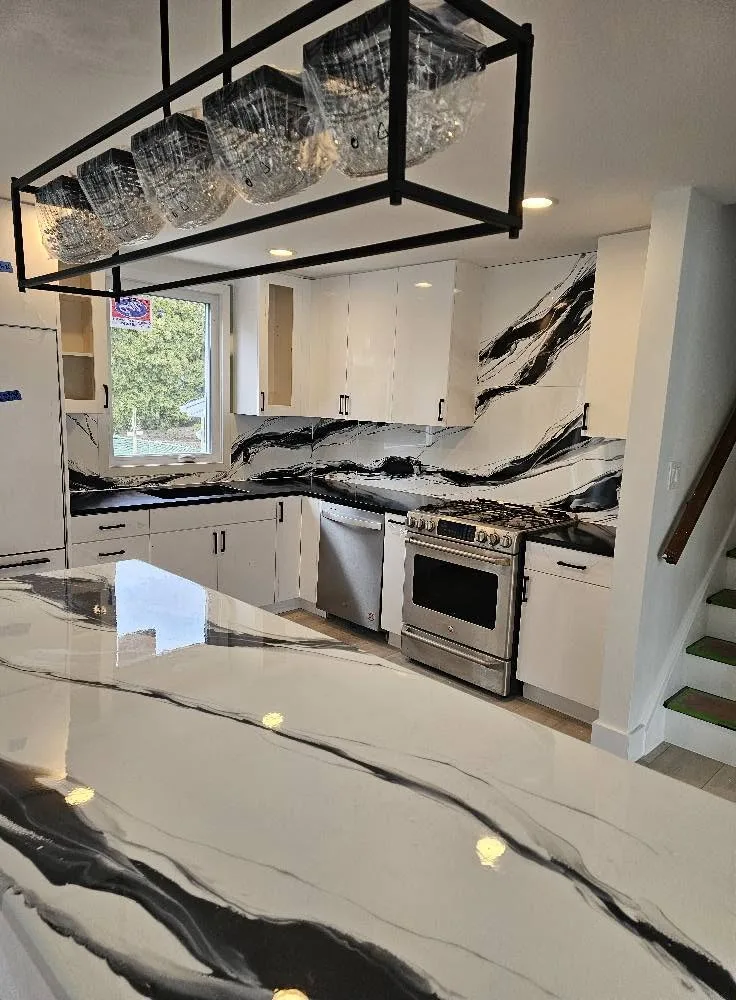
Building on the counter you already have
Laminate, tile and older stone can all take a poured top when the base under them is tight. Danny checks for counters that flex when he leans on them, seams that have lifted, tiles that sound hollow and edges coming away from the cabinets. Any of those has to be fixed before resin goes down, because a poured top only stays as sound as whatever it sits on. If a section is too far gone, he says so at the walkthrough and explains what would need replacing first.
Each base gets its own prep. Laminate is sanded so the resin has something to grip. Tile gets its grout lines filled flat, since every joint left low would show through the finished surface as a faint grid. Old stone is cleaned of sealers and scuffed. Backsplash edges, the wall line and the cabinet faces below are taped and covered, and the floor around the run is protected, because resin finds anything left open. Prep like this is slow on purpose, and it decides how the top looks long after the pour.
A poured top is only as steady as the counter under it, so the base gets checked before any color talk.
Islands are where a poured top shows off, since you see it from every side. Danny plans the edges with the top so the color wraps over them as one piece instead of stopping at a seam. Sink cutouts and cooktop openings get worked around carefully, and your plumber or appliance installer takes those fixtures out beforehand and sets them back after the cure. Overhangs, corners and the spot where an island meets a wall each get planned at the first look so nothing surprises anyone mid-pour.
The look is the fun part. Marble-look veining in cream, gray or white suits a kitchen that wants to stay calm, and it can be laid in soft or sharp. Bolder clients go for deep color, metallic movement or a little glitter caught in the layers. Bathroom vanities are a good place to try something brave, since the surface is small. If a metallic counter has you thinking about the floor too, that is its own job, covered on the Garwood metallic floor page.
How a countertop pour runs, start to finish
A countertop job is short on square footage and long on detail. The house gets covered and the old surface gets prepared before any color goes on in layers. Here is the order Danny follows, so you know what each visit is for and when the kitchen is yours again.

Walkthrough at the counter
Danny looks at the base, the edges, the sink and anything set into the top, then asks what the kitchen should feel like. He brings samples so you can hold them next to your cabinets and your light. You leave knowing whether the counter can take a pour, and what prep it needs.
Covering the room
Plastic and tape go over the cabinet faces, the backsplash, the floor and any doorway the dust could travel through. Appliances near the run get covered too. Danny keeps the work area sealed off because sanding throws fine dust and liquid resin drips, and neither belongs on the rest of your house.
Prepping the old top
Chips and loose edges get repaired first. Then laminate is scuffed and tile joints are filled level so the base reads as one solid plane. Stone gets cleaned of old sealer and scuffed. This is the step people never see in the finished photos, and it keeps a poured counter from lifting or showing ghost lines.
Pouring in layers
The base coat goes down first, then the color layers that carry the veining or the metallic movement. The design is worked by hand along the top and down over the edges, so the pattern runs continuous around an island. Danny plans it and is there for every pour, watching the resin as it settles and levels.
Cure and the final look
The top cures undisturbed with the room closed off. After that your installer resets the sink and fixtures, the plastic comes down, and Danny walks the counter with you. He goes over care, points out the edges and cutouts, and answers anything you noticed while it was curing.
Counters in Garwood’s older houses
Garwood is a Union County borough full of older houses. In an older kitchen, the counter may be decades newer than the cabinets under it, or the other way around. That mix is fine for a pour. What matters is whether the whole run sits level and tight, since a house that has settled over the years can pull a counter slightly out of true.
Keeping the cabinets is often the point. A poured top lets an owner hold on to cabinet boxes and doors that still close well, and change only the surface everyone sees. Out-of-level spots get corrected during prep so the resin levels evenly instead of running toward one end. Tile counters from an earlier remodel need the most filling, and Danny checks each tile by tapping before deciding the run can stay.
Not every counter in town sits in a single-family house. Garwood has apartment buildings near its houses, and a kitchen or bathroom in one of those units can take a poured top too, as long as the building allows the work and Danny knows how the materials get in. A vanity is a smaller job than an island, with the same prep and the same care. For everything else Danny does around town, start at the Garwood service area page, or send a note.
From the Cranford shop, Garwood is roughly a mile’s drive west, close enough that a countertop walkthrough is easy to fit in.
Before you commit to a poured counter
Can you pour over tile with grout lines?
Usually, if the tiles are tight and none of them sound hollow when tapped. The grout lines get filled and sanded flat before any resin goes down, otherwise the grid can telegraph through the finished top. Loose or cracked tiles have to be reset or removed first, and Danny tells you at the walkthrough which way your counter goes.
Who takes out the sink and the cooktop?
Your own plumber or appliance installer. Sinks, faucets and anything set into the counter come out before prep starts and go back in after the top has cured. Danny works out the timing with you so those visits line up with his, and he leaves clean cutouts so the fixtures sit right when they return.
How long is the kitchen out of use?
Long enough that you should plan meals somewhere else for the stretch. The exact timing depends on how much prep the old counter needs, how many layers the design takes and the temperature in the house while it cures. Danny lays it out after the walkthrough, so you can plan around it before the work is booked.
Will hot pans and knives hurt the surface?
They can. A blade leaves scratches in cured resin, and a pot straight off the burner can mark it in a way that is hard to undo. Cutting boards and trivets solve both, and they are worth leaving out on the counter. Wipe with mild soap and a soft cloth, and skip scouring pads.
Can a bathroom vanity get the same treatment?
Yes. A vanity top is a smaller pour with the same steps: protect the room, prepare the old surface, pour the color and let it cure. The basin and faucet come out and go back like a kitchen sink. Its small size also makes it the place to test a bold color before committing a kitchen to one.
Can the look match marble, or does it have to be bold?
Either works. Marble-style veining can be soft and cloudy or crisp and dark, laid over cream, white or gray. If you want louder, deep colors and metallic pigment give a counter real movement. Danny shows samples against your cabinets and backsplash so the choice is made in your light, and every top comes out one of one.
More floors in Garwood
Other floors and surfaces Danz Handz pours for Garwood homes and businesses:
Danz Handz
Danny Carrero, epoxy specialist
dhepoxy@gmail.com
Cranford, NJ. Mon to Sat, 8 to 6. Hablamos español.
Tell Danny about the floor
Book a walkthrough and Danny will look at the counter you have now, hold samples up to your cabinets and tell you plainly what a pour would take. Call (908) 577-7104.