
Plenty of Kenilworth’s postwar houses went up with a single-car garage, and some of those garages were later pushed out sideways to hold a second car. From the driveway the result looks like one room. Down at floor level it is often two slabs poured years apart, butted together at a joint that never quite matches. Coating a garage like that takes more planning than a garage poured all at once, and most of it happens before the grinder comes out.
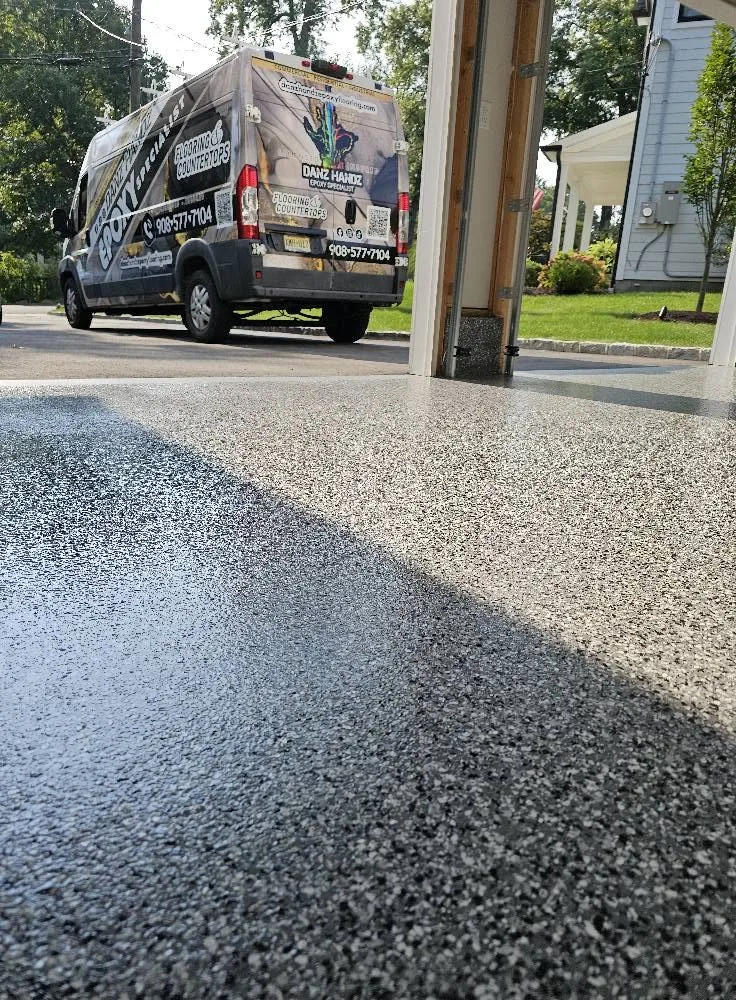
Two slabs that only look like one
An addition slab is usually poured to meet the old one, sometimes with a strip of expansion material between them and sometimes with nothing at all. The two pieces of concrete were mixed differently, cured differently and have settled on their own terms ever since. Run a hand across the seam and you can often feel a small step.
The newer half may also be harder and smoother, while the older half has decades of oil and salt worked into its surface. That difference shows up the moment the grinder touches each side. Danny grinds both until they share a similar open texture, since a coating holds best when the whole floor takes it the same way.
Any step at the joint gets ground down or built up so the floor reads flat. A small lip under a tire is easy to ignore on bare concrete. Under a glossy coat, it catches the light and draws the eye to the one spot you wanted hidden.
Deciding what happens at the seam
A joint between two slabs will keep moving a little with the seasons. Coating straight over it and hoping usually ends with a crack running through the new floor along the old line. The better choice is to decide on purpose how the seam is treated.
One option is to fill it with a flexible material and let the coating stop and start on either side, leaving a thin, straight line that looks intentional. Another is to turn the seam into a design feature, such as a narrow band of a contrasting color dividing the two bays. Some owners like that, since it marks each parking spot.
Which one suits the garage depends on how much the joint moves and how the owner wants the room to look. Danny checks the seam on the walkthrough, shows both treatments, and is plain about which one he expects to hold up better on that particular pair of slabs.
Where the cars sleep during the job
A two-car garage on a narrow lot usually comes with a short driveway, so the first practical question is where both cars spend the job. Owners line up a spot on the street, a relative’s driveway or a friend’s empty space before the date is set. A neighbor who knows what is going on is less likely to park in front of the house that week.
Everything else in the garage has to leave too: bikes, the mower, shelving, the second refrigerator, the boxes. The floor gets ground from wall to wall, so even a small cabinet left in a corner leaves a patch that cannot be coated well later.
Many owners rent a small storage unit for the week or tarp a pile in the backyard if the forecast is dry. Start the clear-out a weekend ahead. It always takes longer than people expect, especially in a garage that has quietly become the household’s attic.
Flake in one bay, metallic in the other?
A flake floor is the workhorse for daily parking. The chips hide grit, tire marks and drips between cleanings, and a textured topcoat over them gives good grip on wet winter mornings. A metallic floor is the showpiece, glossy and deep, and it suits a car that comes out on weekends and gets washed more than it gets driven.
In a garage with two different jobs, some owners ask for both. That can work when the seam between the slabs is the natural dividing line, and the colors are chosen so the two halves still belong together. A gray and black flake beside a black and silver metallic is one pairing that tends to sit well.
Most people still choose one system for the whole floor, since a single surface makes the room feel bigger. Danny brings samples of each so the owner can stand in the doorway, picture both cars parked, and decide which picture they like better.
Salt, the apron and both doors
Two doors means two strips of concrete that take the worst of winter. Wet tires carry salty slush straight in, and it sits in front of each door until it dries into a white crust. The apron where the slab meets the driveway is often the most worn concrete in the garage for exactly that reason.
Before coating, those strips get extra attention: pitted areas are repaired, and the coating is carried right to the outside edge so water cannot work under it. A topcoat with grit near the doors adds traction where people step out of the car in boots.
The two-car garage floor page for Kenilworth lays out the full order of work, and the two-car garage epoxy flooring page explains the systems. A garage that also holds a workbench may suit the plan on the Kenilworth workshop floor page.
Questions
Where does everything in the garage go during the job?
Out of the room entirely, since the grinder and the pour need bare floor wall to wall. Most owners use the driveway, a shed, a basement corner or a borrowed spot at a neighbor’s for a few days. Shelving bolted to the wall can usually stay if the base is clear. Danny goes over what has to move on the walkthrough.
How is the edge finished where the garage meets the driveway?
The coating stops at the door line, where the slab meets the apron, and that edge is ground and finished cleanly so it does not catch a tire or a shovel. If the apron is a separate pour or asphalt, it stays as it is. A chipped or sunken apron edge is pointed out on the first visit.
Will the two halves look different once they are coated?
Not once the floor is down. Older and newer concrete can differ in color and texture, but the coating covers both in one continuous finish. Where the slabs differ in height or roughness, the prep evens them out first so the two halves read as one floor underfoot as well as by eye.
If your garage grew from one bay to two, schedule a visit so Danny can see the seam for himself, and look through finished garages in the gallery. Call (908) 577-7104.