
Three, four or five colors poured as one floor
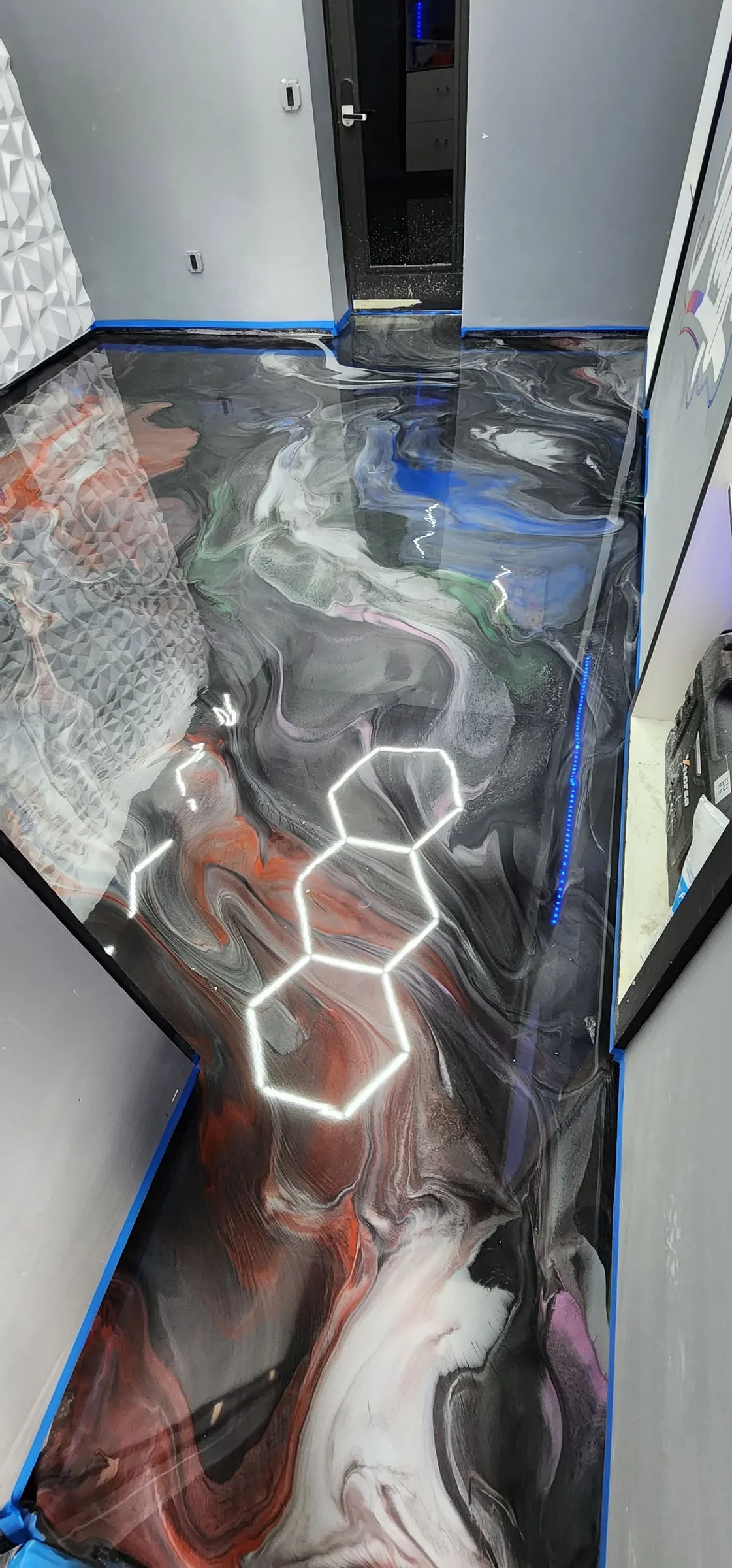
Three or four colors moving together in one floor takes more planning than one, because each one has to sit right beside the others. Danz Handz pours multi-color metallic floors where the colors are chosen as a set, laid out with you on samples and guided by hand while they are still wet, so they blend where you want a blend and hold a line where you want contrast. Garages, hallways, game rooms and basements all take them well. The whole service is on the multi-color epoxy flooring page.


Choosing colors that belong together
Most people arrive with one color they love and a loose sense of the rest. Danny starts from that favorite and builds around it, usually with one dark color to anchor the floor, one or two in the middle and a bright one used sparingly. He brings sample boards so the set can be judged together, side by side, in the room where it will live. A combination that looks great on a phone screen can turn muddy in a basement lit by two small windows, and the boards catch that before any resin is mixed. The sample board preparation page shows how those boards are made.
There are two broad ways to run several colors. Bold bands keep each color fairly distinct, with crisp edges where one meets the next, like the orange, black and charcoal stripes that cross one of his garage floors. Soft blends let the colors drift into each other, so the floor shifts tone as you walk over it. Bands suit a garage or a game room that wants energy, and blends suit a hallway or a living space where the floor should feel calm underfoot. Plenty of floors mix the two, with one bold streak running through softer color.
Pick the colors as a set, in the room’s own light, and the floor holds together once it is poured.
Where the colors meet is where the floor is really made. They go down wet, one beside another, and Danny works the movement by hand while the resin is still open, pulling one tone into the next or keeping them apart. He sets the direction ahead of time: toward a door, down the length of a hallway, out from a bar or a TV wall. That planning is what lets several colors read as a single design. It is also why no two of these floors match, even when the colors are the same. The metallic epoxy flooring page shows the single-color side of the same craft.
Danny describes his part as getting inside the client’s head, taking the picture they have been carrying around and making it real on the floor, without anyone driving themselves crazy along the way. So the conversation runs longer than it does for a one-color floor. He asks what the room is for, what hangs on the walls and what you want people to notice first. He also teaches hands-on epoxy classes on metallic work, which keeps him close to how pigments behave beside each other. If one of your colors has to match a sample exactly, epoxy floor color matching covers it.
Sampling the set, then pouring it in one go
A multi-color floor is decided long before pour day. Most of the early work is choosing, testing and arranging the colors, so the day the resin goes down is about carrying out a plan that is already settled.
Talking through the room
On the walkthrough Danny looks at the slab, the light at different times of day and what the room gets used for. He asks about the colors you like and the ones you cannot stand, and he starts sketching where the movement could run. You leave with a rough idea of the set.
Boards in your own light
Sample boards with the proposed colors poured together come back to the house so you can see them by daylight and under your own fixtures. Swapping a color or changing its share of the floor happens here, while it is still easy. Some people go through two or three rounds before they are sure.
Prep and the base
The slab is ground to an open surface, cracks and pits are filled, and moisture is checked if the room is a basement. A base coat goes down to give the colors an even ground. The base color matters more than most people expect, since it shows through the thinner parts of the pour.
Pouring the colors
The colors go down in the planned order and positions, then get worked by hand while they are wet. Danny plans the layout and is there for the pour, steering how the bands or blends meet. The movement is set in that short window, which is why the design was settled before anyone opened a bucket.
Topcoat and the final walk
A clear topcoat goes over the finished colors, with texture added where the floor gets wet or sees shoes from outside. Once it has cured, Danny walks the floor with you, points out where each color landed and explains how to keep the finish looking clean.
Bold floors for Kenilworth’s lived-in houses
A multi-color floor fits best in the rooms people spend real time in: a finished basement, a garage that doubles as a hangout, a hallway everyone crosses a dozen times a day. Many Kenilworth houses date from the 1950s, and rooms from that era often run smaller, so Danny often suggests letting one lighter color take the largest share of the floor and saving the bolder ones for the movement through it. A strong orange or blue reads bigger in a small room than it does on a sample board.
Basements can take more color and personality than a front room upstairs, and they are where a lot of these floors end up. Before any color goes down in a Kenilworth basement, though, the slab gets a moisture test. Postwar slabs in town were often poured on bare earth with no sheet underneath, and the borough’s flood claims lean heavily toward buildings with basements. A damp reading means a moisture-tolerant base goes under the colors, and the design you picked stays exactly as it was.
Danny’s shop is a short drive away in Cranford, so bringing sample boards back for a second look is no trouble. The Kenilworth page lists everything else he does in town. If you would rather have one stone-like look than several bright colors, the marble-look floor page covers that. Finished multi-color floors are in the gallery, or you can tell Danny about the room you have in mind.
The Census dates 13% of Kenilworth’s homes to the 1960s and 11% to before 1940.
Questions about mixing colors in one pour
How many colors can go in one floor?
Three to five is the usual range. Fewer than three tends to read as a single color with an accent, and past five a floor can start to look busy unless the colors sit close in tone. Danny helps you trim or add on the sample boards until the set looks right in the room.
Does the base coat color change how the colors look?
Yes. The metallic colors are thin enough that a dark base deepens everything above it and a light base brightens it, so the same set can look moody or airy depending on what sits underneath. Danny makes the sample boards on the base he plans to use, so the colors you approve are the colors you get on the floor.
Can a multi-color floor work in a hallway?
Yes, and hallways suit it well because the movement can run the full length and lead people through. Narrow spaces usually do better with blends than with hard bands crossing them, which can make a hall feel shorter. Danny plans the direction so the colors flow toward the rooms at either end.
Do bright colors fade in a garage?
Strong sun through an open door can change some colors over time, so the topcoat for a garage or a room with big windows is chosen with that in mind. Danny talks through which colors hold up best in direct light and which are safer kept to the inner parts of the floor.
Is a multi-color floor harder to keep clean?
Not really. The routine matches any coated floor: sweep or dust mop, then go over it with a damp mop and a neutral cleaner. The movement and the mix of tones tend to hide dust and small marks better than one flat color does. Felt pads under furniture keep the topcoat from scratching.
Can glitter or flake go in with the colors?
Often, yes. Glitter worked into a metallic pour catches the light as you walk across it, and some floors carry a band of flake through a working area. These mixes get planned on the sample boards like everything else, so you see how they sit together before Danny commits to the pour.
More floors in Kenilworth
The other Kenilworth pages, each about a different kind of floor:
- Marble-look floorsVeins and clouds poured in place.
- Two-car garagesBoth bays, one floor, one schedule.
- Workshop floorsFloors for benches, bikes and projects.
- Old coating removalOff with the failing coat.
- KenilworthEvery other Kenilworth floor, in one place.
- Multi-Color Epoxy FlooringThe service, anywhere Danny works.
Danz Handz
Danny Carrero, epoxy specialist
dhepoxy@gmail.com
Cranford, NJ. Mon to Sat, 8 to 6. Hablamos español.
Schedule a look at your floor
Book a walkthrough and Danny will look at the room, talk through the colors you have in mind and bring sample boards back so you can see the set together. Call (908) 577-7104 to set a time.