
Grinding off the coating that already let go
A coating that has started to peel will keep peeling, whatever goes on top of it. Danz Handz takes failed floors back to bare concrete: roll-on garage kits flaking under hot tires, gray paint wearing through on a basement floor, and coatings that lifted after water sat on them. In Kenilworth, where the 1940s and 1950s together account for most of the houses, that old layer often sits on a slab poured straight onto the soil, so whatever turns up under it gets checked as carefully as the removal itself. The full service is on the old epoxy removal page.


Why a new coat never goes over a failing one
The trouble with a peeling floor is that the bond has already failed under more of it than you can see. Press a thumbnail under the edge of a flake and the coating often lifts a few inches further. A new layer rolled over that only grips the old one, so when the old film lets go, the new floor comes up with it, usually in the tire paths first. That is why removal gets planned as part of the new floor from the very first visit. Once the old coating is gone, everything poured after it has sound concrete to hold onto.
Each kind of old floor comes off a little differently. A roll-on kit from a hardware store is thin and usually brittle by the time it peels, and the grinder clears it quickly. Basement paint can be several coats deep, sometimes with a darker color underneath from an owner before last. A thicker epoxy that held up a long time and then lifted in sheets takes the longest, because the parts still bonded are bonded hard. Danny scrapes a test patch on the walkthrough to see which one he is dealing with, which tells him how long the grinding will run.
A new floor is only as good as what it sticks to, and a peeling coating has already stopped sticking.
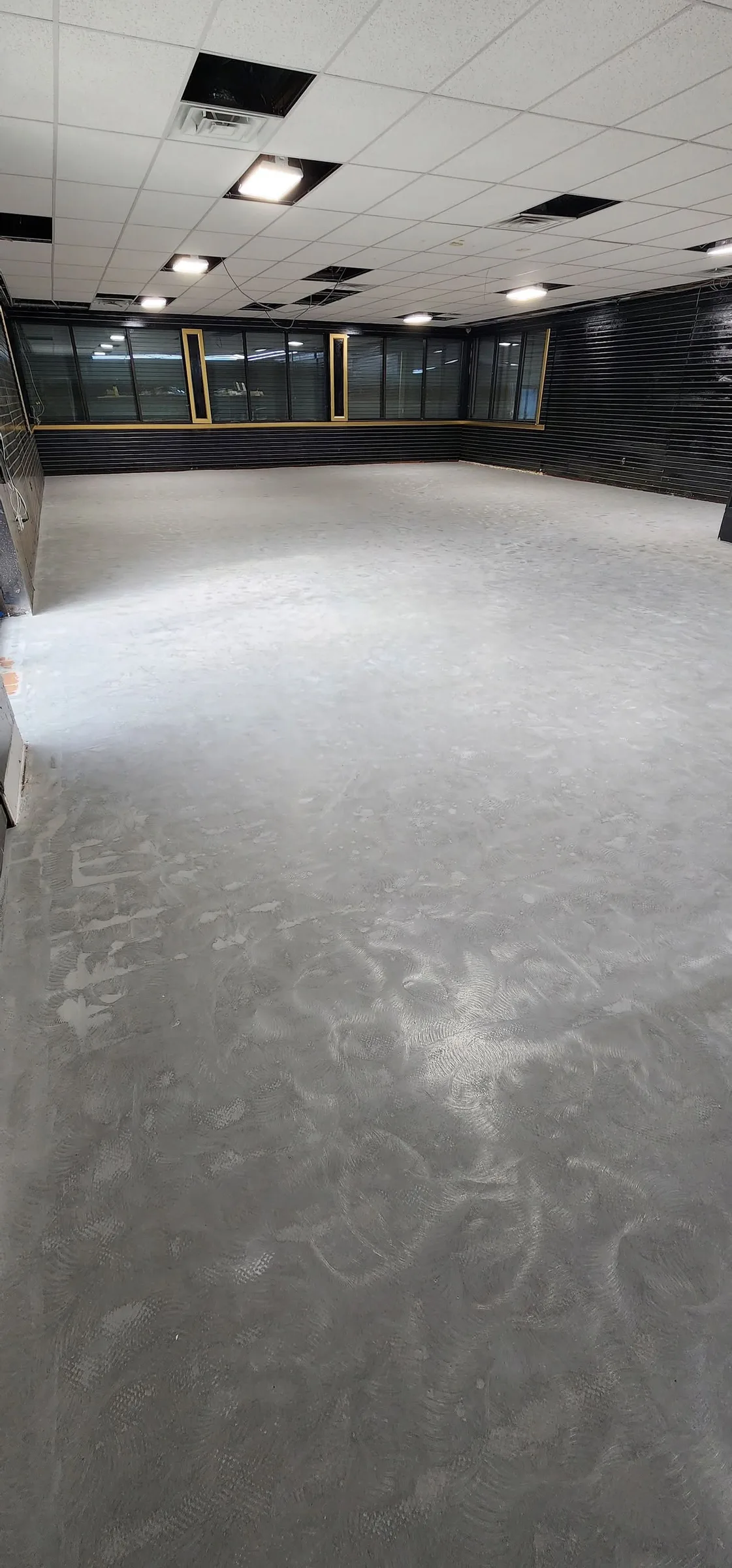
The removal itself is done with a walk-behind grinder and diamond tooling, hooked to a dust extractor that pulls the debris off the floor as it is cut. Edges along the walls and around posts get a smaller hand grinder. The goal is a slab that is clean, open and dull, with no shiny islands of old coating left behind. Where the old film has left adhesive or residue in the pores, those spots get another pass. The concrete profile preparation page explains what that open surface looks like and why a primer needs it.
Once the old layer is off, the concrete finally shows its real condition. Pitting from salt, hairline cracks that were painted over and patches from earlier repairs all come into view, and they get filled and ground flat before any color is chosen. The slab is also tested for moisture at this stage, since a coating that lifted on its own was sometimes pushed off from below. A damp reading points to a moisture-tolerant base under the new system, as the moisture testing page describes. Chips and pits are handled the way concrete pitting repair lays out.
Taking a floor back to bare concrete
Removal days are the loud ones, so they get planned around the household. Danny sets the order with you at the walkthrough: what has to move, which doors stay shut, and when the quieter part of the job begins.
A test patch on the walkthrough
Danny scrapes and grinds a small area to see how the old coating is holding, how many layers are down and what color shows underneath. He looks for water marks along the walls and around the drain, and he talks through what the new floor could be once the old one is gone.
Sealing off the rest of the house
Doors to the living space are closed and taped, vents nearby are covered, and anything left in the room is wrapped. The dust extractor runs the whole time the grinder does, but a basement or attached garage is still treated as a work zone until the slab is clean.
Grinding to sound concrete
The walk-behind grinder works across the open floor while a smaller one follows the edges, the steps and the posts. Danny checks the surface as the work moves along, and any patch that still shines gets another pass. Loose flakes and debris are vacuumed up, never swept back across the slab.
Testing and repairs
With the slab bare, moisture readings are taken in more than one spot, and the cracks, pits and old patches the coating hid are filled and ground flush. If the readings come back damp, the plan for the new floor changes right here, before anything is mixed or poured.
The new floor goes down
From here the job runs like any new install: primer, the color or flake system you picked, then the topcoat. Danny plans the system around what the removal turned up and is there for the pour. Most people never see their bare slab again after this day, which is why it gets looked over so closely.
Old coatings in Kenilworth’s postwar basements and garages
Many garages and basements from that era have been coated already, often a homeowner with a weekend kit or a can of floor paint. On slabs from the 1950s, the decade behind the biggest share of the town’s houses, those coatings were usually rolled over concrete that was never ground, and many of those slabs rest on soil with no plastic sheet beneath them. Moisture working up through the slab is one of the slower reasons an old coating turns white, blisters or lets go in patches.
Water from above does the same thing faster. The borough’s flood insurance claims bunch up after Hurricane Irene, and a coating that has sat under standing water rarely bonds the way it did before. If your basement or garage took water in 2011, in 2021 or at any point since, say so on the first call. Danny tests those floors before planning anything new, and a damp slab gets a vapor-mitigation base under the new system.
Danny comes over from his shop in Cranford for the walkthrough, so a quick look at a peeling floor is easy to set up. The Kenilworth page covers the rest of his work in town, and once the old coating is gone, the multi-color floor page shows one way to use the clean slab. Finished floors are in the gallery, or you can send Danny a few photos of the peeling spots.
FEMA counts 136 flood insurance claims from the Borough of Kenilworth in 2010 or later.
Before the old coating comes up
Can a new epoxy floor go over my peeling one?
No. A new coat bonds to the surface under it, and a peeling coating has already lost its grip on the concrete, so anything poured on top would come up along with it. The old film is ground off down to sound concrete first, and the new system goes onto that clean, open slab.
Where does the old coating go once it is ground off?
Into the dust extractor hooked to the grinder, along with the thin layer of concrete that comes up with it. Loose flakes that peel ahead of the grinder get swept and bagged as the work goes. When the slab is clean, it is vacuumed again so nothing from the old floor ends up under the new one.
My basement flooded once. Can it still get a coated floor?
Usually, yes. A slab that has taken water can carry a new floor once it has been tested. Danny takes moisture readings after the old coating is off, and if the concrete reads damp, a vapor-mitigation base goes down before the color. The readings decide the system, so nothing about it is guessed.
Do you remove painted basement floors too?
Yes. Floor paint comes off the same way a failed epoxy does, with a grinder and dust extraction. Older paint can be several layers deep, and an earlier color hiding under the top coat is common. Danny grinds a test spot on the walkthrough to see how many layers he will be cutting through.
Why did my garage coating peel in the first place?
Most often the slab was never ground before the coating went on, so it sat on a smooth, dusty surface with little to grab. Hot tires, road salt and moisture rising from below all speed the failure. Seeing the floor tells Danny which of those caused yours, and the new plan answers it.
How much time does removal add to the job?
That depends on what is coming off. A thin kit coating clears quickly, while thick old epoxy or several coats of paint take longer, and repairs found underneath add time as well. Danny gives you the schedule after the walkthrough, once he has ground a test patch and seen the layers for himself.
More floors in Kenilworth
Other pages for Kenilworth homes, garages and basements:
- Marble-look floorsVeins and clouds poured in place.
- Two-car garagesBoth bays, one floor, one schedule.
- Workshop floorsFloors for benches, bikes and projects.
- Multi-color floorsSeveral colors, one pour.
- KenilworthEvery other Kenilworth floor, in one place.
- Old Epoxy RemovalThe service, anywhere Danny works.
Danz Handz
Danny Carrero, epoxy specialist
dhepoxy@gmail.com
Cranford, NJ. Mon to Sat, 8 to 6. Hablamos español.
Start with a visit
If a floor is flaking, bubbling or lifting at the edges, have Danny look at it before anything new goes on. He will grind a small test spot, check for signs of moisture and lay out how the removal fits into the new floor. Call (908) 577-7104.