
Pearl metallic, the quiet side of a poured floor
A pearl metallic has the depth of any poured floor without shouting about it. The color is soft, a cream or ivory with a slow sheen moving through it, and it shifts as daylight crosses the room. It suits kitchens, foyers and lower levels where a bold swirl would take over. Danny tests pearl tones in your actual room before one is chosen. Ask for a look at your floor to start.


How pearl reads beside a high-contrast swirl
A high-contrast metallic, black against gold or charcoal against white, grabs attention from across the room. Pearl works the other way. The color stays close to one tone, and the interest comes from the sheen, a soft movement that shows up as you walk past. People who choose pearl usually want the floor to feel calm and expensive at once, with the furniture and the room doing the talking. The look is described on the pearl effect metallic flooring page.
Light is what brings pearl to life. Tall windows throw long bands of daylight across it in the morning, and a chandelier in a foyer turns into scattered points of glow on the surface at night. Rooms with a lot of glass get the most out of it. In a lower level with small windows, recessed lights and lamps do that job instead, so Danny looks at where the fixtures sit before he plans the color.
A pearl floor is judged on the floor itself, in the room’s own light, never in the cup.
A quiet color is less forgiving of the slab under it. A busy swirl hides a trowel mark or a patched crack inside its own movement. Pearl lays everything out flat and even, so a ridge or a dip catches the light and gives itself away. That is why prep on a pearl floor gets extra time: the grind goes further, repairs are feathered out wider, and the surface is checked under a low light before primer goes on.
Strong sun can yellow a standard clear coat over the years, and that shows sooner on cream than on a dark color. For rooms with big south or west windows, Danny talks through a topcoat that holds up better to UV; the UV-resistant floor topcoats page has the details. Pearl also pairs well with a whole-house pour when the main floor connects room to room.
Sampling a soft color, then pouring it
With pearl, the sampling visit carries more weight than usual, because the gap between ivory, cream and sand is small in a cup and large across a floor. Danny settles the tone in the room itself before anything is mixed.
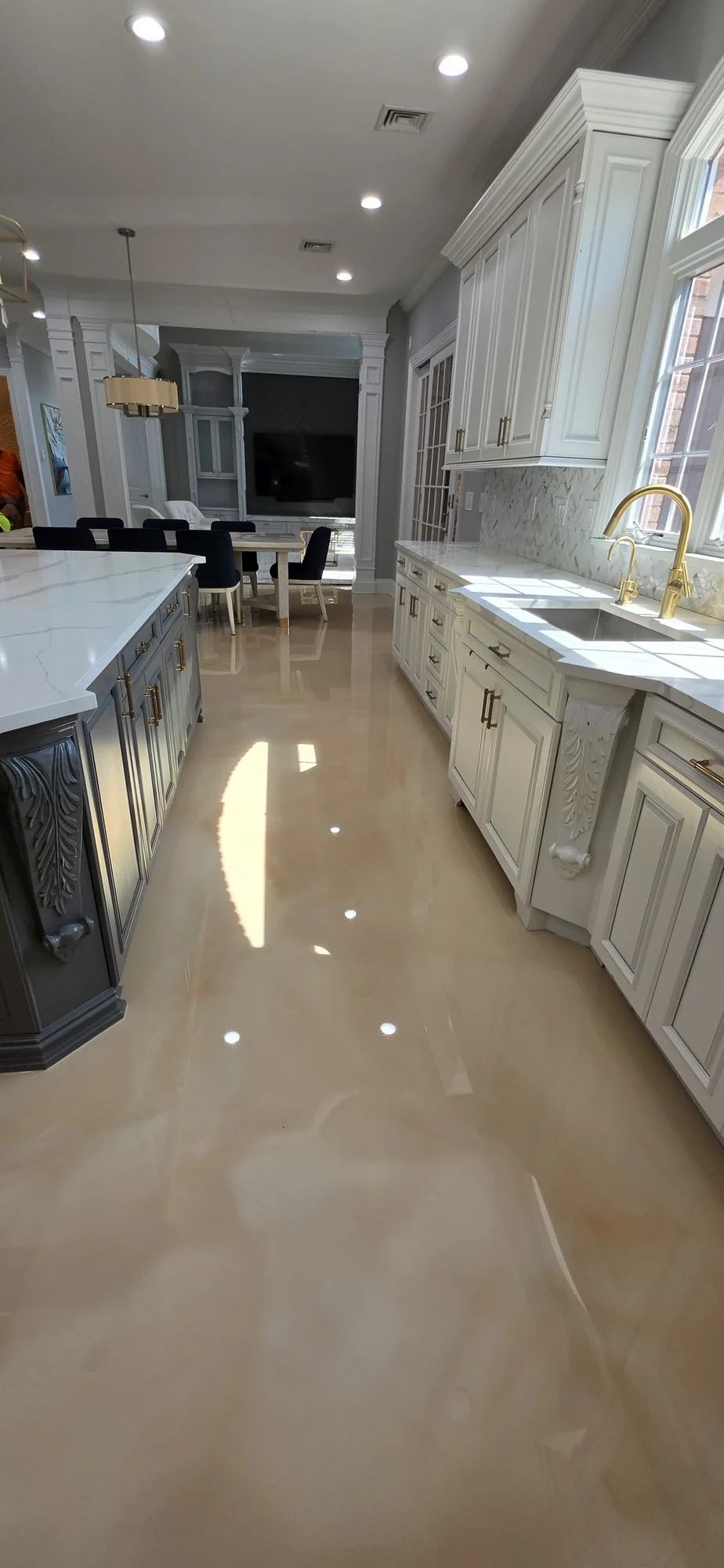
Sample in the actual room
Pearl, cream and sand samples go down on the floor where the pour will be. Danny looks at them with you in daylight, under the overhead lights and with the lamps on. The tone that holds up in all three is usually the right one.
A deeper grind
The slab is diamond ground past old coatings and adhesive to clean, open concrete. Because pearl shows texture, the grinder makes extra passes over rough patches. Trowel ridges left from the original pour come down at this stage.
Feathered repairs
Cracks are filled and ground flush, and patches are blended out wide so their edges vanish under a soft color. Low spots get leveled. A light held low across the slab then shows any spot that still needs another pass.
Prime and lay the pearl
Primer seals the concrete. The pearl coat goes on and is worked by hand so the sheen drifts gently across the room instead of bunching up. He is on hand for the pour, watching how window light falls on it as it settles.
Topcoat and a walk in daylight
A clear coat goes over the pearl, chosen for the sun the room gets. Once cured, the floor gets a walk at the hour you use the room most, and Danny goes over cleaning, pads and mats at the doors.
Soft colors in Westfield’s oldest houses
A large share of Westfield’s houses went up before the Second World War. If yours has tall windows, wide trim or a staircase worth looking at, a soft metallic sits under all of that without competing with it. Where these houses have concrete, it is usually in a lower level, and that is where a pearl floor turns a plain room into one the family actually uses.
Old concrete in a house this age is often soft on top and out of level, and a pearl finish shows every bit of that if it goes on too soon. Grinding and patching come first, and on an older lower level a moisture test decides which primer goes down. Danny reads the slab with you and is direct about how much work it needs before any color gets picked.
A soft, bright floor can suit a storefront as well, and the salon and spa floor page covers that kind of space. Past cream and pearl floors are in the gallery, and the other floors poured around town are listed on the Westfield page.
About 37% of Westfield’s homes were built before 1940, and the Census puts the town’s median build year at 1953.
Pearl tones, light and upkeep
What is the difference between pearl and a regular metallic?
Pearl stays close to one soft color, usually cream, ivory or sand, and its movement comes from sheen. A regular metallic often mixes two or three strong colors into visible swirls. Both are poured the same way. The effect on the room is where they part company.
Does pearl show dirt more than a dark floor?
It shows dark grit and pet hair more than a mid-tone floor would, and it hides dust better than black does. A dust mop every day or two keeps it looking clean. Mats at the outside doors catch most of what would otherwise end up on it.
Why does pearl need more prep than a busy floor?
A soft, even color has nothing to hide flaws inside, so ridges, dips and patch edges catch the light. The slab gets more grinding passes and wider, feathered repairs, then a check with a low light across the surface before any primer goes down.
Will a cream floor yellow in a sunny kitchen?
A standard clear coat can amber over the years in strong direct sun, and cream shows it sooner than darker colors. Danny asks about the windows and can choose a UV-resistant topcoat for bright rooms. In a lower level with small windows it rarely comes up.
Can pearl go in a basement or lower level?
Yes, once the slab passes a moisture check. A pale floor brightens a lower level noticeably, which helps in rooms with only a couple of small windows. If the concrete reads damp, a primer made for that condition goes down before the pearl coat.
How do I choose between ivory, cream and sand?
Look at them on your own floor under your own lights. Ivory reads cleanest next to white cabinets, cream warms up a room with wood trim, and sand sits well beside stone. Danny brings all three and leaves them down long enough to watch them change through the day.
More floors in Westfield
Other floors Danny plans for Westfield houses and shops:
- Metallic garage floorsA garage floor with real movement in it.
- Whole-house floorsLiving rooms, foyers and kitchens.
- Salon floorsNail salons, spas and barbershops.
- Shop floorsStorefronts, showrooms and boutiques.
- WestfieldEvery other Westfield floor, in one place.
- Pearl-Effect Metallic FlooringThe service, anywhere Danny works.
Danz Handz
Danny Carrero, epoxy specialist
dhepoxy@gmail.com
Cranford, NJ. Mon to Sat, 8 to 6. Hablamos español.
Book a walkthrough
Set aside an hour when the light in the room is at its best, and Danny will bring pearl samples to put down on the floor. Call (908) 577-7104 to book a walkthrough.