
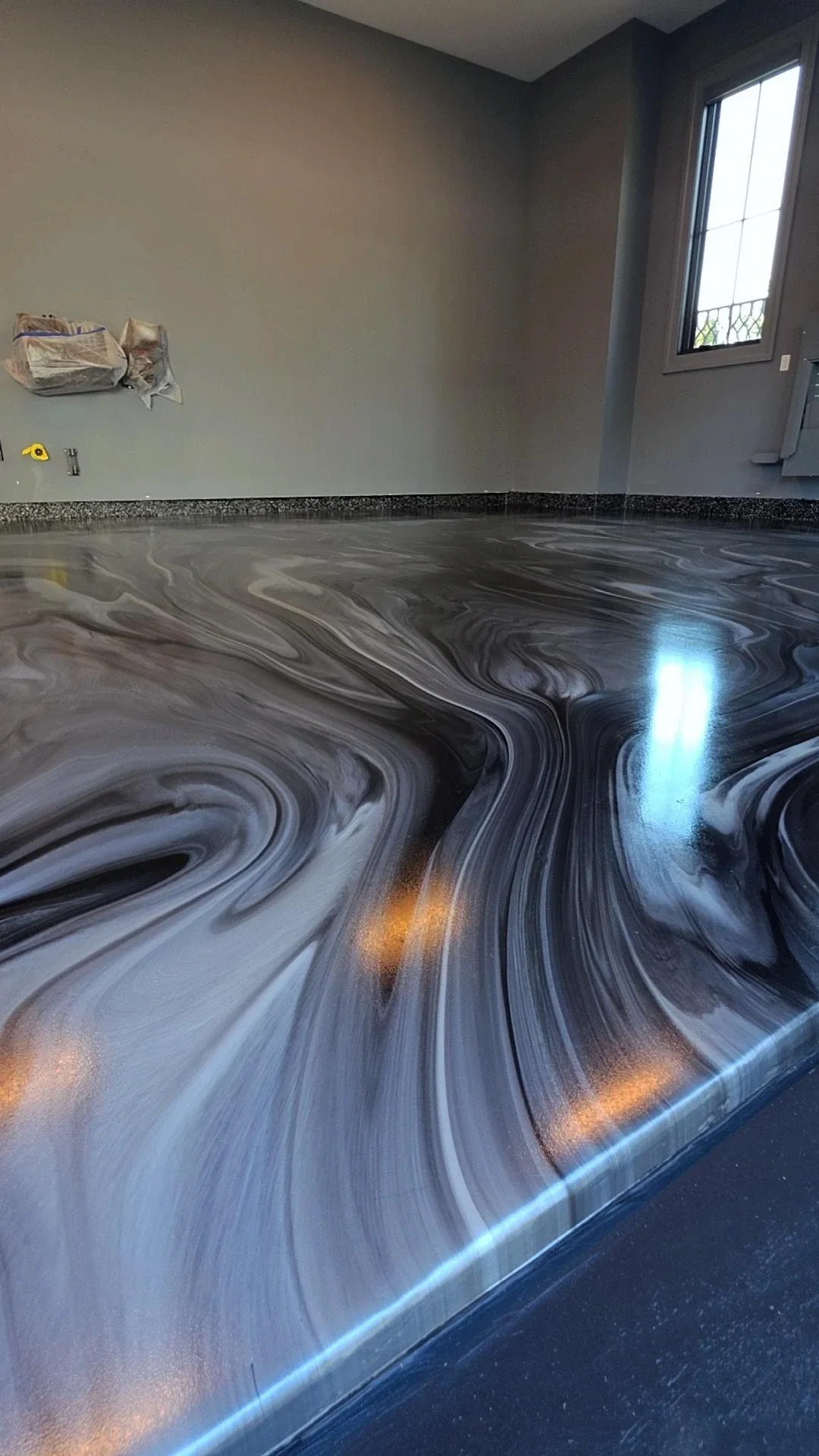
A marble floor poured in place, veined by hand
A poured marble look skips the slabs, seams and grout of real stone: it is built inside the epoxy, with the veins and soft clouds drawn by hand while the coat is still wet. So the look is decided with you before the pour, on samples, with a plan for where the boldest veins should run. Ask for a visit and have the room you are picturing in mind.


Stone veins drawn into a wet coat
A metallic marble starts from a base color, usually white, cream or black, and the veining goes in on top while the epoxy can still move. Danny works the lines with tools and a steady hand, pulling some thin and sharp and letting others spread into a haze, the way real stone looks where two minerals meet. The coat sets on its own clock, so there is no stopping halfway to rethink a vein. How these floors are built is laid out on the metallic marble epoxy flooring page.
That is why placement gets settled first. On the samples, you and Danny decide how busy the veining should be, which way it should travel and where the strongest line belongs. In a living room it might angle away from the front door; in a basement bar it might run toward the counter. A rough sketch of the room with the furniture drawn in keeps the loudest marks out from under the sofa, where nobody would ever see them.
The boldest vein should land where people actually look, so it gets placed before the pour.
White and gray marble looks sharpest against something dark. A black fireplace surround, espresso cabinets or a charcoal accent wall gives the pale floor an edge to play off, and a few of the veins pick up that dark tone so the room ties together. For a bolder room the colors can flip: a black floor with white crackle veins reads like polished stone in a hotel lobby, and it suits a bar, a media room or a powder room meant to surprise whoever opens the door.
No two marble pours come out the same, even with the same colors and the same hands. A sample board gives you the character of the floor, and the real pour finds its own version of that character as it levels out. Danny is straight about that at the walkthrough, and most people end up liking it, since the result is a floor nobody else has. If you would rather see several colors moving together than a stone look, the multi-color floor page covers that.
From bare concrete to finished stone
A marble floor has two halves: the prep that gets the slab ready and the pour where the stone takes shape. Danny explains both at the walkthrough and sets the days, so you know when each room is out of use.
Samples and a vein plan
Danny sets marble samples down in the room and looks at them with you in daylight and under your own lights. Together you settle the base color, the vein color and the direction the main lines should travel, and he notes it on a sketch of the room.
Moisture reading, then the grind
Any slab below grade gets a moisture reading before work begins. A diamond grinder then opens the concrete, taking off old paint, glue and the weak top layer so the primer has something to grab.
Patch and level
Cracks are filled and ground flat, and low spots are brought up. A pale marble shows a ridge or a dip more than a busy pattern does, so the repairs are feathered wide and checked with a light held low across the slab.
Base coat and hand veining
Primer seals the slab, then the base color goes down. While it is still wet, the veins and clouds are worked in by hand following the plan. Danny is there for this stage, since it is the part of the job that cannot be redone.
Clear coat and the first walk
A clear topcoat goes over the marble to protect it from shoes and furniture. After it cures, you walk the floor together and go over felt pads, rugs and everyday cleaning.
Pale stone in Kenilworth’s postwar houses
The typical Kenilworth house dates from the mid-1950s, and houses from the 1950s often have smaller windows than newer ones. A lighter marble helps in rooms like that. White and soft gray bounce around whatever daylight comes in, so a den or a finished basement reads brighter than it did on old carpet or tile. A darker crackle look still works in those houses; it just wants good lamps and a room where the drama is the point.
In a 1950s house, a marble look often ends up in the basement, and a basement slab from that era often sits right on the soil with nothing to stop damp working up through it. Kenilworth basements have also taken on water in big storms. So a light marble never goes down on a guess: the slab gets a reading first, and the concrete moisture testing page explains how it is taken. A damp result means a vapor mitigation base goes in before any color.
Marble floors from past jobs are in the gallery. A garage can take a stone look too, and the two-car garage page covers floors built for cars. Everything Danny plans around the borough is listed on the Kenilworth page.
Of the Kenilworth flood insurance claims in FEMA’s records that note a foundation, 89% were for buildings with a basement.
Questions about a poured marble look
Does a poured marble floor look like real stone?
From standing height it reads very much like polished marble, with veins, clouds and depth. Up close it is smoother and has no seams or grout lines, since it is one continuous coat.
Can I choose where the veins go?
Yes. The direction of the veining and the spots for the strongest lines are agreed on samples and sketched on a plan of the room. Each vein is still drawn by hand in a wet coat, so the exact shapes are new, but the layout follows what you chose.
Will a white marble floor show dirt?
It shows dark grit and pet hair more than a mid-tone floor would, and the gray veining hides some of it. A quick pass with a dust mop keeps it looking clean, and mats at the outside doors stop most of the dirt before it gets that far.
Can marble go down in a basement that has flooded?
Often, once the slab has been tested. A basement that took on water can hold damp in the concrete for a long time, so Danny takes a moisture reading first. If it comes back high, a vapor mitigation base goes down before the marble coat.
Is black marble with white veins harder to live with?
A dark floor shows dust and fine scratches sooner than a pale one, so it suits a room with lighter traffic, like a bar, a media room or a powder room. Felt pads under chairs and a rug where they slide keep the gloss looking right.
Will my floor match the photo I saved?
It will be close in color and character, though never a copy, because every marble pour forms its own pattern. Bring the photo to the walkthrough. Danny looks at what draws you to it, whether that is the vein weight, the contrast or the colors, and builds the samples around that.
More floors in Kenilworth
Other floors Danny plans for Kenilworth homes:
- Two-car garagesBoth bays, one floor, one schedule.
- Workshop floorsFloors for benches, bikes and projects.
- Old coating removalOff with the failing coat.
- Multi-color floorsSeveral colors, one pour.
- KenilworthEvery other Kenilworth floor, in one place.
- Metallic Marble Epoxy FlooringThe service, anywhere Danny works.
Danz Handz
Danny Carrero, epoxy specialist
dhepoxy@gmail.com
Cranford, NJ. Mon to Sat, 8 to 6. Hablamos español.
Schedule a look at your floor
Bring a photo of the stone you like, and Danny will set marble samples down in the room where it would go. Call (908) 577-7104 to book a walkthrough.