
A roll-on garage floor kit looks great for the first season. Then a patch lifts where the car parks, a corner starts to flake by the door, and soon hot tires are pulling chips off and tracking them into the house. Owners often wonder whether a fresh coat over the top will fix it. It will not, and the reasons are worth knowing before anyone opens another can. Here is what is usually going on, and how the old coating comes off.
Why kit coatings let go
Most kits are thin, and many are applied over concrete that was only washed or etched with acid, never ground. That leaves a smooth, sealed top layer for the coating to grab, which is a weak grip from the start. The first warm afternoon a car pulls in on hot tires and sits for the night, the softened coating sticks to the rubber and comes up with it.
Moisture finishes the job. Water rising through the slab gets trapped under a coating that cannot breathe, pushes up bubbles and breaks the bond from below. In a garage that took water in a storm, the damage can spread quickly once it starts.
None of this is the homeowner’s fault in particular. The kit simply was not built for what a garage floor goes through, and the prep printed on the box is rarely enough for older concrete.
Why a fresh coat cannot go over a failing one
A coating is only as strong as what it sits on. Laying a new floor over an old one that is already lifting means the new floor is glued to something that is coming loose. Within months the same patches lift again, now taking two layers with them.
Even the parts of the old kit that look fine are suspect. If one area has let go, the bond across the rest of the floor is usually weak too, just not tested yet. Danny checks this by scraping at the edges and tapping across the floor for hollow sounds before anything is decided.
So the rule is simple. The old coating comes off, all of it, and the new system bonds to bare, ground concrete. That step adds time to the job, and it is also the step that keeps the next floor on the slab.
Grinding it off without dusting the house
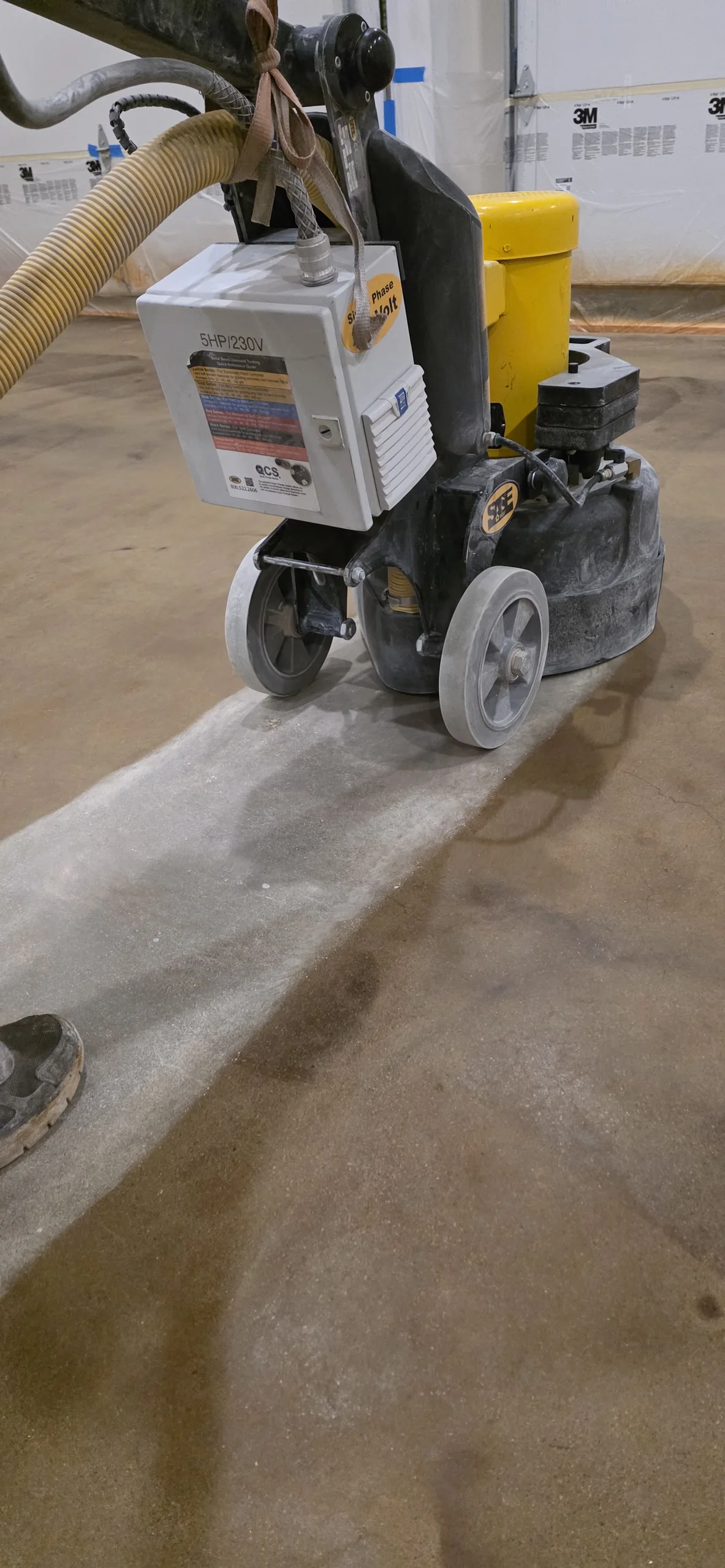
Peeling coatings come off with a walk-behind diamond grinder that cuts through the old layer and opens the concrete underneath in the same pass. Loose areas may be scraped first. Edges and corners the big machine cannot reach get a hand grinder.
The grinders run hooked to a dust extractor, which pulls the fine dust straight off the floor into a bag instead of letting it float. That keeps the work far cleaner, though it is still loud, and doors into the house stay closed with plastic over any gaps. The garage door is usually open for air.
When the grinding is done, the slab looks like plain concrete with fine swirl marks across it. Any spots where the old coating hid a problem, like a pitted patch or a crack, show up clearly at that point, which is exactly why they wait until then to be judged.
What sat under the old coating
A kit coating can hide a lot. Oil soaked into the concrete before it was applied. Pits from years of salt. Cracks that were filled with something soft and painted over. Sometimes a layer of paint lies under the kit, left by an owner before that one.
Each of those gets dealt with before the new floor. Oil spots are cleaned or ground until the concrete underneath is sound. Pits and cracks are filled and ground flush. Any old paint comes off along with the kit.
Then the slab gets a moisture reading. FEMA counts 90 flood insurance claims from the Borough of Kenilworth after Hurricane Irene in 2011 and 28 more after Ida in 2021, and a coating that failed from below may have been pushed off by water. A damp result means a moisture-tolerant base goes down first.
Painted basement floors tell the same story
The same thing happens below grade. Many basement floors were painted with gray or red porch paint at some point, and paint on a basement slab tends to peel in sheets once moisture gets behind it. FEMA counts 136 borough claims from 2010 or later, so a basement floor painted before then may have been wet since.
Paint gets ground off exactly like a kit coating, and a basement slab is tested for moisture before anything new goes down. If the reading is high, the new floor starts with a vapor-control layer, then the color.
The old coating removal page for Kenilworth covers the grinding and repair in order, and the old epoxy removal page explains the process. Once the slab is bare, a fresh floor like the ones on the two-car garage page for Kenilworth can go down.
Questions
Can I peel the old kit off myself to save time?
You can scrape off whatever lifts easily, and some owners do. The parts still stuck will need grinding regardless, since a scraper leaves a film behind that a new coating will not bond to well. Clearing the garage and pulling the loose flakes is a fine head start. Leave the rest for the grinder.
How do I know if my coating is failing or just dirty?
Scrape a fingernail or a putty knife at the edge of a worn spot. If it lifts or flakes, the bond has let go. Hollow sounds when you tap the floor, bubbles, and white rings near the door are other signs. Danny checks for all of these when he comes out to look at the floor.
Will grinding damage my concrete?
Grinding takes off the old coating and a very thin top layer of concrete, which opens the surface so the new floor can hold on. It does not weaken a sound slab. Where the concrete under a failed coating is already crumbling, those spots get cut back and rebuilt before anything new is applied.
If your garage kit or basement paint is coming up, talk to Danny before more of it lets go, and browse finished floors in the gallery. Call (908) 577-7104.