
Coated restroom floors with no grout lines
The ring around a toilet base and the grout lines by the stalls show where a restroom has been soaking up mop water for years. That is where Danny starts. He pours one surface over the ground slab and can carry it a few inches up the wall, so the dirty line at the base goes too.


How Danny approaches commercial bathroom floor coatings
The coating is a resin system poured over the concrete slab after it has been ground and repaired. It cures into one continuous layer with no grout joints for dirt and urine to settle into. Danny can carry the coating up the base of the walls so the corner where floor meets wall, which is where mops leave a dirty line, becomes part of the same surface. Solid colors are the usual pick for restrooms, and a flake broadcast is an option when the owner wants a speckled floor that hides water spots between cleanings.
Existing tile can sometimes stay, but only if it is tight to the floor; loose or cracked tile comes up first.
It fits restrooms on a concrete slab: ground-floor and basement restrooms in offices, shops, restaurants, gyms and event spaces. Upper floors over wood framing are a different story, since wood moves and a hard coating can crack along with it, and Danny will say when a floor is the wrong base. Existing tile can sometimes stay, but only if it is tight to the floor; loose or cracked tile comes up first. A restroom also has to close for the pour and the cure, so a building with one restroom needs a plan for that.
Danny walks the restroom first and looks at the spots that tell the story: the ring around each toilet base, the floor drain, the grout lines and any soft or hollow tile. Then the floor is cleared down to sound concrete and diamond ground, and cracks and low spots around the drain get repaired so water runs toward it and stops pooling at the stalls. He pours the coating with fixtures removed or worked around, depending on what the owner and plumber prefer, and finishes the wall base if it is part of the job. After the cure, he walks the room with the owner and checks the edges at the door and drain.
Grout lines are where a restroom floor gets dirty first, and a poured floor has none.
From bare slab to finished floor
A restroom job runs around the plumbing. The order of work is set by who pulls the toilets, when the partitions come loose, and when the plumber can come back to reset them.


Tracing the odor to its source
Danny kneels at each toilet base and the floor drain and checks how far stains and smell have reached. Urine that has worked under tile for years often soaks the concrete below, and that tells him how much grinding the room will need before anything new goes over it.

Fixtures off, flanges noted
When the owner’s plumber pulls the toilets, Danny marks each flange and partition anchor. A poured floor adds a little height around every opening, so he and the plumber agree on how each flange will sit once the coating is down and the toilets go back.

Grinding out the stained concrete
Old tile, mortar and adhesive come off, then the slab is diamond ground until clean concrete shows. Soaked areas around the bowls get extra passes, and any spot that still smells is treated or cut out, so the coating seals over sound concrete and leaves the old problem behind.
Pitching to the drain, then the cove
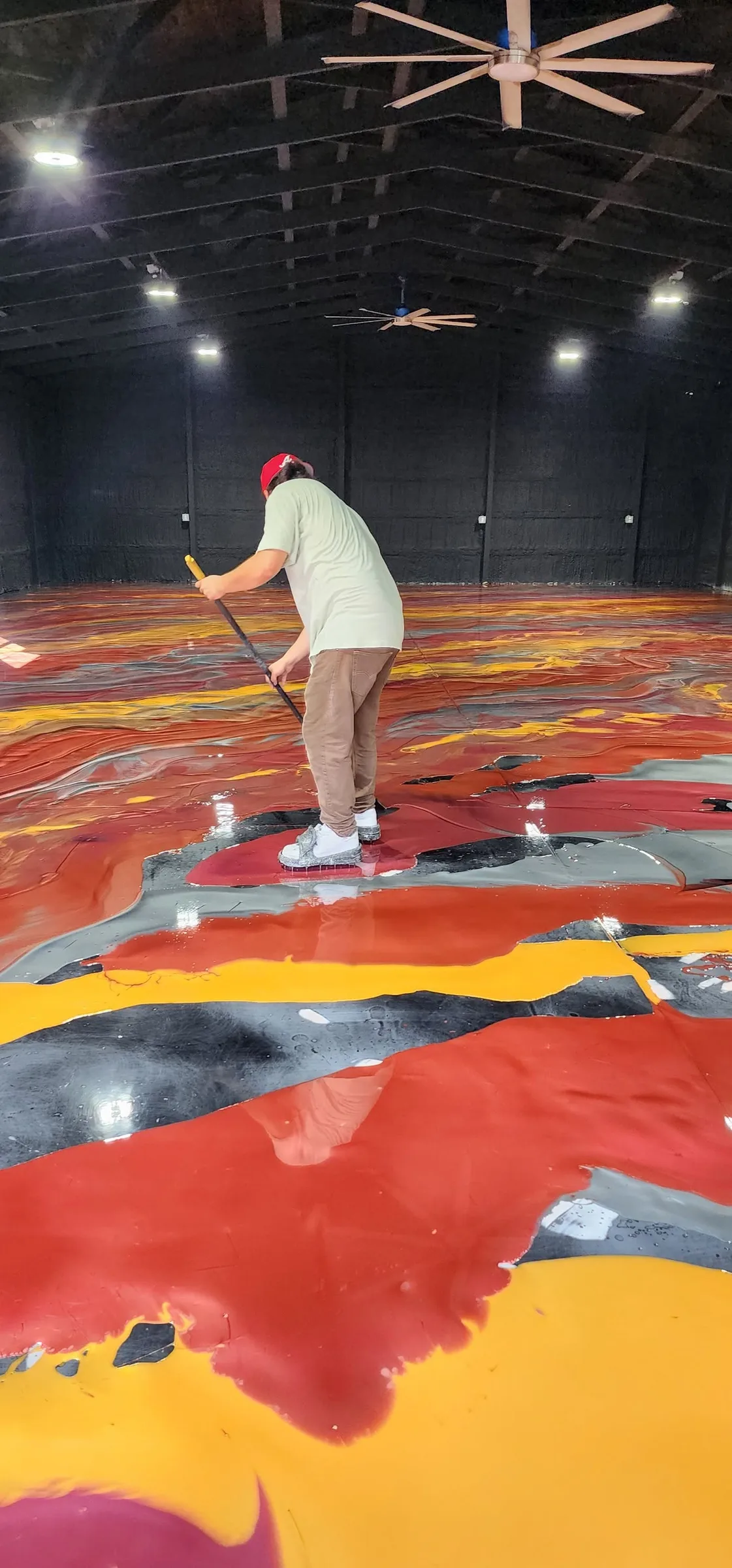
Low spots are filled so mop water heads for the floor drain. The cove is formed along the walls first, then the floor is poured to meet it, with the topcoat textured lightly in front of sinks and urinals where water lands most often.

Resetting toilets and partitions
After the cure, the plumber sets new wax rings and the partition feet go back on their anchors. Danny then runs a bucket of water across the floor with the owner watching, so both can see it head to the drain and stay off the walls.
More of Danny’s floors
Other jobs from the file, not all of them this service. See the gallery







Questions about commercial bathroom floor coatings
Can you coat over our existing restroom tile?
Sometimes. If the tile is tight to the slab and the grout is sound, a coating system can bond over it after grinding. If tiles sound hollow when tapped, are cracked, or the floor flexes, they come up first, because a coating over loose tile will crack along the same lines. Danny checks this during the first walk-through.
Does the coating go up the wall?
It can. Carrying the coating a few inches up the wall gives the restroom a rounded, wipeable joint where the floor meets the wall, which is where mop water and dirt collect. It works best on masonry or another solid wall surface. Danny looks at the walls during his visit and tells you whether the base makes sense for that room.
How do we keep a restroom available for customers?
If the building has more than one restroom, the usual approach is to do them one at a time so one stays open. With a single restroom, owners often schedule the work over a closed day or bring in a temporary option. Danny works out the timing with you after he sees the room, so you know how long it will be out of service.
Will the coating get rid of the urine smell?
Usually, when the source is in the old grout and the top of the slab. Grinding removes the stained layer, and the coating seals what is left so it stops soaking up more. If the smell turns out to come from a dry floor drain or a failing wax ring, that is a plumbing fix, and Danny will point it out.
Do the stall partitions have to come down?
Floor-mounted partitions usually come off their anchors so the coating can run under where the feet stood. Ceiling-hung and wall-hung partitions often stay put, with only the stall doors propped open. Danny looks at how yours are mounted on the first visit, and the plan for the room is built around that.
Can urinals on the wall stay while the floor is done?
Wall-hung urinals usually stay, since they sit above the floor. The coating and cove are worked up underneath them with a clean edge at the wall. Floor-mounted urinals are treated like toilets and come off for the pour, then the plumber sets them back once the floor has cured.
More from the commercial section
Salons, barbershops, showrooms, restaurants, offices, gyms and clinics, worked around your hours.
- Medical Office FlooringContinuous resin floors for exam rooms, halls and waiting areas, chosen with the practice’s cleaning products and any flooring requirements in hand.
- Dental Clinic Resin FlooringResin floors poured cleanly around dental chairs, floor boxes and cabinets, light in the operatories and warmer in the waiting room.
- Veterinary Clinic Floor CoatingsSealed vet clinic floors with flake and texture options that hide claw marks, wash down in kennel areas and give paws grip.
- Gym and Fitness Studio FlooringCoated floors for gym lobbies, locker rooms and studio rooms, planned around rubber in the weight areas and texture where floors get wet.
- Hotel Back-of-House FlooringContinuous floors for hotel service corridors, linen rooms and receiving, done in sections so housekeeping keeps moving during the work.
From Union County out to the Lehigh Valley, Long Island and Fairfield County, the work is all within about 60 miles of Cranford. See every areaSee the gallery
Danz Handz
Danny Carrero, epoxy specialist
dhepoxy@gmail.com
Cranford, NJ. Mon to Sat, 8 to 6. Hablamos español.
Start with a visit
Send a few lines about the room and the look you want. Danny will call and set up a time to see it.