
Coating a concrete driveway, with honest limits
Hot tires, oil drips, road salt, freeze and thaw, and a snow plow blade every winter: a driveway takes more abuse than any other slab on a property. The first question most homeowners ask is what coating, if any, will actually hold up out there, and Danny answers it after he has seen the concrete.

How Danny approaches driveway coatings
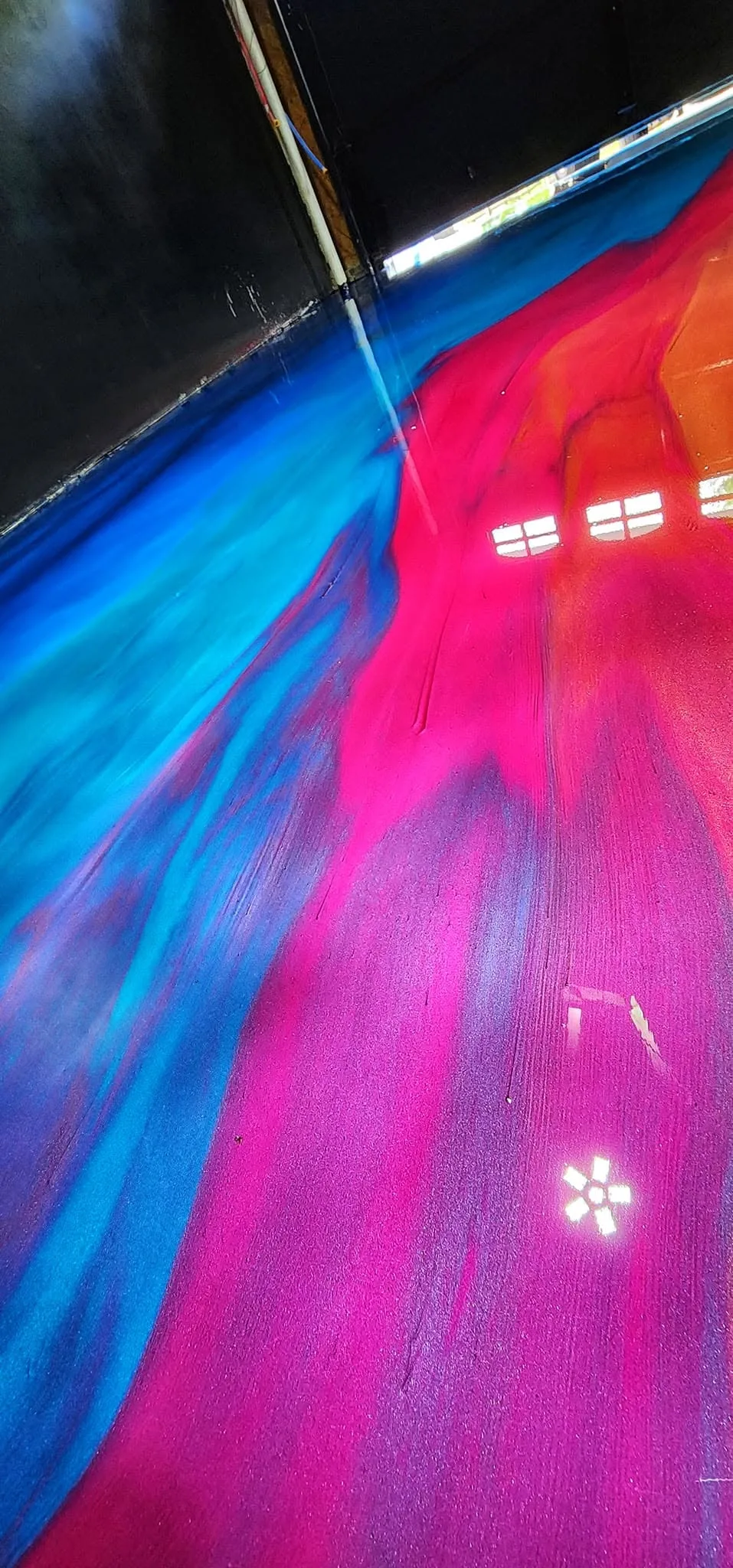
A driveway coating is an exterior resin system applied to a concrete driveway, usually as a flake broadcast with a textured topcoat chosen from the product data for vehicle traffic and outdoor exposure. Danny grinds the surface, repairs cracks, pitting and salt damage, and levels low spots where water and slush sit. The finished driveway hides oil spots and tire marks better than bare concrete and gives the front of the house a cleaner look. It only applies to concrete. Asphalt driveways are a different material and outside what Danny coats.
The finished driveway hides oil spots and tire marks better than bare concrete and gives the front of the house a cleaner look.
Driveways are a tough place for any coating, and Danny is upfront about it. Hot tires can leave marks, plows and shovels scrape, and salt wears topcoats faster than anything indoors. Driveways that have heaved, sunk or cracked into moving slabs will crack the coating along the same lines. For some driveways a penetrating sealer is the better fit, and Danny will recommend that when it is. A well-prepped coating on a sound driveway, with sensible winter care, is the realistic goal.
Danny walks the driveway from the street to the garage and looks for cracks, heaved joints, salt pitting and oil stains. He asks how many cars park there, whether a plow service clears it and how much salt goes down each winter. If the slab is sound, he plans the job for a dry stretch. He diamond grinds the driveway, repairs cracks and pitting, and levels low spots. The coating goes down with a textured topcoat, and the driveway stays closed to cars through the cure. The final walk covers plow blades, salt and hot tires.
A driveway coating is only as steady as the ground under the slab.
Five stages, every time
A driveway job begins with an honest call on whether to coat it at all. When the answer is yes, these stages take it from the street end to the garage door.

Deciding coat or seal first
Before anything else, Danny and the owner decide whether the driveway is a candidate for a full coating or would do better with a penetrating sealer. That call comes from the slab’s condition, the winters it faces and how much upkeep the owner wants to take on.

Grinding out the tire paths
The strips where tires roll every day carry the most rubber, oil and salt residue. Those lanes get extra cleaning and grinding passes until they match the rest of the slab, and any oil drip spot near the garage is chased out.

Repairing the street end
The bottom of a driveway near the curb takes plow damage, salt runoff and the weight of turning trucks. Spalled concrete and broken edges there are cut back and rebuilt so the coating does not start chipping where the plow hits first.

Coating in joint-line sections
On a long driveway, the coating goes down section by section between control joints so each pass ends at a natural line. The textured topcoat follows, and the slab stays closed to every vehicle until the cure is done.
Tying in at the garage door
Where the driveway meets a coated garage floor, the blend can carry through at the door, with the change finished cleanly at the slab joint. Danny suggests the owner pass the winter notes along to whoever plows the driveway.
More of Danny’s floors
Other jobs from the file, not all of them this service. See the gallery






Questions about driveway coatings
Will a coating hold up on my driveway?
On a sound concrete driveway with good prep and sensible winter care, a coating can look good for a long time. It still faces hot tires, salt and plows, which wear any surface. Danny looks at the slab and how the driveway gets used, then tells the owner honestly whether a coating or a sealer makes more sense.
Can you coat an asphalt driveway?
No. Danny’s systems are for concrete. Asphalt is a different material that moves and softens in ways a resin coating cannot follow, and it is maintained by asphalt paving and sealing companies. If part of a driveway is concrete, like the apron near the garage, that section can be coated on its own.
What about the hot tire marks people talk about?
Tires coming off hot pavement can leave marks on many coatings, and on some they lift the topcoat. The topcoat choice and the color both affect how much shows. Letting the car cool on the street for a while after a long summer drive is one habit some owners pick up. Danny explains the tradeoffs before the job.
Can the driveway match my coated garage floor?
It can come close. The driveway takes an exterior system and a textured top, which can change how a flake blend reads compared with the smoother garage floor. Using the same flake blend usually ties the two together well. Danny brings both samples outside so the owner can see them side by side in daylight.
Where do the cars go while the driveway cures?
Every vehicle parks on the street or somewhere else for the full cure, delivery trucks and guests included, so check local parking rules ahead of time. On some wide driveways Danny can split the work lengthwise and leave one side open, though that adds a seam down the middle.
Does a coated driveway need recoating?
Over time, yes. Salt, plows and tires wear the topcoat first, usually in the tire paths and at the street end. Recoating the top before the color layer wears through keeps the driveway looking even. Danny explains what early wear looks like so the owner knows when to call (908) 577-7104 for a look.
Related floors
Patios, pool decks, porches, walkways and driveways, finished with UV-stable topcoats for sun and weather.
- Covered Porch CoatingsCoated finishes for concrete front and side porches, with old paint ground off and colors chosen to suit the house.
- Exterior Stair CoatingsRebuilt edges and a textured exterior coating for outdoor concrete steps, matched to the porch or walkway they lead to.
- Balcony Concrete CoatingsExterior finishes for concrete balconies, with flaking and cracks repaired and drainage checked before the coating goes down.
- UV-Resistant Exterior Concrete CoatingsExterior coatings and topcoats chosen for slabs in steady sun, so patios, entries and garage aprons hold their color.
- Outdoor Commercial Walkway CoatingsExterior coatings for walkways outside shops and offices, done in sections so customers and tenants always have a way in.
Danny works out of Cranford, NJ and covers about 60 miles: North and Central Jersey, the city and Long Island, the Hudson Valley counties, Fairfield County and eastern Pennsylvania. See every areaSee the galleryRead: What Road Salt Does to a Garage Floor, and How a Coating Helps
Danz Handz
Danny Carrero, epoxy specialist
dhepoxy@gmail.com
Cranford, NJ. Mon to Sat, 8 to 6. Hablamos español.
Start with a visit
Tell Danny what you are working with. He will call, then come look before anyone talks numbers.